I have recently been evaluating Google’s Open Knowledge Format (OKF). My initial assessment is that the framework is intentionally minimalist.
Author: Ravi Kiran
Author profile: Ravi Kiran writes practical AI engineering guides for GenAITrail, with a focus on AI agents, RAG, MCP, local LLM workflows, developer tooling, and applied enterprise AI architecture.
Author expertise: Ravi’s coverage focuses on turning emerging AI standards into implementable engineering patterns for developers, technical founders, and AI teams.
Relevant experience: This article is based on hands-on evaluation of Google’s Open Knowledge Format, related AI-agent knowledge workflows, and practical comparisons with RAG, MCP, semantic search, and project-local knowledge bundles.
Publication date: September 2026
Updated date: September 2026
Table of contents
- What Open Knowledge Format is
- Why AI agents need structured knowledge
- Open Knowledge Format vs RAG
- Anatomy of an OKF bundle
- Project-local knowledge for coding agents
- OKF v0.2, provenance, trust, and attestation
- When NOT to use Open Knowledge Format
- Primary sources
- FAQs
Primary-source note: This article prioritizes official documentation, Google Cloud announcements, the Open Knowledge Format GitHub repository, and related specification material over secondary commentary.
Fundamentally, an OKF bundle consists of a straightforward directory of Markdown files, which may optionally include YAML frontmatter for metadata and index.md files for structural organization.
Open Knowledge Format FAQ and implementation checklist
What is Open Knowledge Format? Open Knowledge Format is a portable way to package knowledge for AI agents using readable Markdown and metadata. Open Knowledge Format helps teams move context between tools without locking it inside one vendor platform.
Why does Open Knowledge Format matter for agents? Open Knowledge Format gives agents structured context, provenance, and reusable knowledge bundles. Open Knowledge Format is useful when an agent needs more than a prompt, because Open Knowledge Format can carry definitions, references, examples, and trust signals together.
How is Open Knowledge Format different from ordinary RAG? Open Knowledge Format can still support RAG, but Open Knowledge Format is more explicit about the shape of the knowledge. A RAG pipeline can index Open Knowledge Format bundles, while Open Knowledge Format itself remains a source format that humans and agents can inspect.
Where should teams start with Open Knowledge Format? Start with one narrow domain, convert the most important docs into Open Knowledge Format, and keep the bundle small enough to review. Open Knowledge Format works best when the first bundle solves a real agent task instead of trying to model the whole company at once.
What should an Open Knowledge Format bundle include? A good Open Knowledge Format bundle includes concept pages, frontmatter, references, lifecycle notes, and clear links between related ideas. Open Knowledge Format becomes more valuable when each page says where the knowledge came from and when it should be refreshed.
When should teams avoid Open Knowledge Format? Avoid Open Knowledge Format when the problem is only a one-off prompt or a temporary note. Use Open Knowledge Format when the knowledge needs to be shared, versioned, audited, searched, or reused by multiple agents.
Related GenAITrail AI engineering guides
As Below:
product-specs/
├── index.md
├── authentication/
│ ├── index.md
│ └── oauth2-flow.md
├── billing/
│ ├── index.md
│ └── tier-upgrades.md
└── compliance/
└── data-retention.md
And an individual knowledge document might look like:
---
type: Technical Specification
title: OAuth 2.0 Authentication Flow
description: Standardized procedure for third-party application authorization.
tags: [security, api, authentication]
owner: security-team
---
# OAuth 2.0 Authentication Flow

All third-party integrations must utilize the Authorization Code grant type with PKCE.

See also [Data Retention Policies](../compliance/data-retention.md) for token logging limits.
If this is just standard Markdown and YAML, why not just drop it in a generic docs/ folder and move on?
In fact, this simplicity is the easiest way to underestimate the Open Knowledge Format.
The true innovation here is not that someone devised a new way to write plain text.
The far more compelling question is:
As autonomous AI agents increasingly need to query, retrieve, and act upon enterprise context, can we agree on a universal, tool-agnostic standard for packaging that knowledge?
That turns out to be a much larger paradigm shift than the file format itself.
The Context Gap: Why Agents Struggle with Domain Knowledge
While modern AI agents excel at writing code, analyzing data, and processing documents, they encounter a significant hurdle when deployed within a real software organization: they lack an intrinsic understanding of domain-specific business logic.
Consider an engineer maintaining an e-commerce application. To determine when an order is officially considered “paid,” they must consult an internal wiki. To understand the fallback process if a payment succeeds but order creation fails, they must reference a technical runbook. To figure out why a specific order is no longer eligible for automated refunds, they might need to dig through a two-year-old product requirements document, a support policy, or simply ask a senior engineer.
The codebase represents only a fraction of the system’s total context. The remainder of this critical knowledge is typically fragmented across a multitude of surfaces, including:
- Internal wikis and product documentation
- PDFs and shared drives
- API specifications and source code repositories
- Project management tools (e.g., Jira) and communication platforms (e.g., Slack)
- The tacit knowledge held within the team itself
This exact fragmentation was the core problem addressed when Google introduced the Open Knowledge Format (OKF) in June 2026. Google noted that while AI agents require rich context to function effectively, that context is overwhelmingly scattered across disparate systems. OKF was proposed not as yet another proprietary knowledge service, but as a portable, interoperable standard for packaging that context.
A single line from the initial announcement perfectly encapsulates this philosophy:
“What’s missing is a format, not another service.”
That distinction fundamentally shifts how we should evaluate OKF. It is not attempting to become another centralized knowledge platform; rather, it aims to standardize the underlying artifact being exchanged between systems, teams, and agents.
The Core Philosophy: A Format, Not a Platform
When Google introduced the Open Knowledge Format (OKF) in June 2026, it identified a critical bottleneck in the AI ecosystem: agents require rich, relevant context to function, but that context is overwhelmingly fragmented across disparate surfaces and systems. OKF was proposed not as yet another proprietary knowledge service, but as a portable, interoperable standard for packaging that context.
One sentence from the initial announcement perfectly encapsulates this paradigm shift:
“What’s missing is a format, not another service.”
That distinction fundamentally changes how we should evaluate OKF. It is not attempting to become another centralized knowledge platform or a walled-garden SaaS product. Instead, it aims to standardize the underlying artifact being exchanged between systems, teams, and agents.
The Power of Producer/Consumer Decoupling
The most important aspect of OKF is not the fact that it uses Markdown. The true innovation lies in its deliberate independence from any specific agent framework, model provider, or serving system.
This creates a clean separation between the producer and the consumer of knowledge:
- A human can write an OKF bundle in their favorite text editor.
- An AI agent can generate one dynamically based on new learnings.
- A CI/CD pipeline can export one automatically from an existing internal catalog.
Crucially, the consumer does not need to use the same technology stack as the producer. The consumer might be an LLM, a semantic search engine, a static documentation site, or a custom knowledge-management tool. As long as it can parse Markdown and YAML, it can consume the knowledge.
Solving the Integration Nightmare
To understand the value of this decoupling, consider how organizations currently handle knowledge integration.
Imagine three different teams exposing their domain knowledge in three distinct ways: Team A uses a proprietary wiki, Team B relies on a custom internal database, and Team C uses a third-party SaaS tool. If an AI agent needs to pull context from all three, it faces three distinct integration problems. If you scale this to 50 teams and 10 different agents, you suddenly have a massive, unmaintainable web of custom connectors.
By adopting a shared knowledge format, the architecture shifts from a chaotic many-to-many integration to a standardized hub-and-spoke model. Teams export their knowledge to OKF; agents read OKF. The knowledge being exchanged suddenly speaks the same language.
Think of it like API descriptions. Anyone can invent their own custom JSON structure to describe an API, and technically, that works. But once the industry agreed on a standard like OpenAPI, an entire ecosystem of tools could instantly understand, validate, and interact with any API description. OKF is exploring that exact same interoperability layer, but for organizational knowledge.
The specification is highly explicit about its boundaries. OKF does not prescribe storage, serving, or query infrastructure. It also does not attempt to replace strict, domain-specific schemas like OpenAPI (for APIs) or Protobuf (for data serialization).
In short: OKF is a format for context, not a platform for infrastructure.
Anatomy of an OKF Bundle
A self-contained collection of OKF knowledge is called a Knowledge Bundle. Within that bundle, each individual Markdown document is referred to as a Concept.
A Concept ID is deterministically derived from the file’s path within the bundle. Furthermore, the specification reserves index.md for directory listings, enabling structural navigation.
For example, a standard product specification bundle might look like this:
product-specs/
├── index.md                  # Root index / table of contents
├── authentication/
│   ├── index.md              # Domain index for Authentication
│   └── oauth2-flow.md        # Concept: OAuth 2.0 authorization flow
├── billing/
│   ├── index.md              # Domain index for Billing
│   └── tier-upgrades.md      # Concept: Subscription tier upgrade logic
└── compliance/
    ├── index.md              # Domain index for Compliance
    └── data-retention.md     # Concept: Data retention and privacy rules
The Killer Feature: Progressive Disclosure for Agents
At first glance, this file-system-oriented design might look almost old-fashioned. Why rely on folders and text files in an era of advanced vector databases?
Because it enables something incredibly powerful for AI agents: progressive disclosure.
Suppose an agent has access to thousands of pieces of product knowledge. The obviously flawed approach is to dump everything into the prompt:
Thousands of documents
          ↓
Load everything into the context window
Nobody building a serious system does this. It exceeds token limits, destroys the model’s attention mechanism, and guarantees hallucinations.
Usually, the industry standard is to add Retrieval-Augmented Generation (RAG)—chunking the text, embedding it, and relying on semantic search to find the right pieces. While effective, RAG often strips away the broader structural context of the organization.
OKF provides a superior, complementary approach. Because of the hierarchical structure and index.md files, an agent can “browse” the knowledge base exactly like a human engineer would, but at machine speed.
- The agent first reads the root
product-specs/index.mdto understand the high-level domains (Authentication, Billing, Compliance). - Realizing it needs to understand how to handle a user moving to a higher pricing tier, it navigates to
billing/index.mdto see what specific billing concepts exist. - It then loads only the specific concept it needs:
tier-upgrades.md.
This allows the agent to dynamically narrow its focus, pulling in only the exact context required for the task while maintaining a deep understanding of how that specific concept relates to the broader organizational structure. It transforms knowledge retrieval from a blind semantic search into a deliberate, structured exploration.
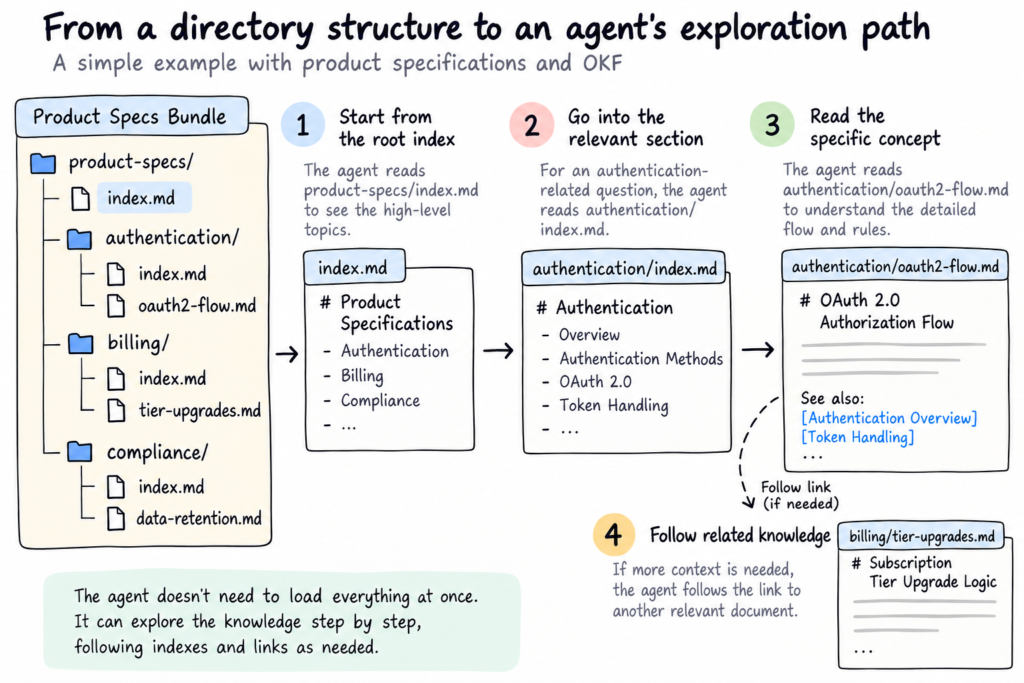
It could begin with the root:
product-specs/index.mdand discover the high-level domains:
Authentication
Billing
Compliance
If the task is about authentication, the agent can move into:
authentication/index.mdand discover:
Authentication Overview
Authentication Methods
OAuth 2.0
Token Handling
Then, if the task specifically requires understanding OAuth, it reads:
authentication/oauth2-flow.mdThat document can provide the detailed OAuth 2.0 authorization flow and may link to other relevant concepts, such as authentication or token-handling documentation.
If more context is required, the agent can follow those links only when they become relevant.
The exploration becomes:
Product Specs Bundle
        ↓
product-specs/index.md
        ↓
authentication/
        ↓
index.md
        ↓
oauth2-flow.md
        ↓
related authentication knowledge
The same pattern works for other domains.
For example, a billing-related task could follow:
product-specs/index.md
        ↓
billing/
        ↓
index.md
        ↓
tier-upgrades.md
And a compliance-related task could follow:
product-specs/index.md
        ↓
compliance/
        ↓
index.md
        ↓
data-retention.md
The important idea is that the agent doesn’t need to load every document at the beginning.
Instead, it progressively discovers the knowledge it needs:
Root Index
    ↓
Relevant Domain
    ↓
Domain Index
    ↓
Specific Concept
    ↓
Related Concept (only if needed)
Rather than deciding at the beginning that every potentially relevant document must be placed into context, the agent can explore the knowledge base step by step, following indexes and links as the task requires.
This is the idea behind progressive disclosure: index.md files allow humans or agents to navigate a hierarchy one level at a time instead of loading the entire bundle into context at once.
And because normal Markdown links can connect concepts across directories, the resulting knowledge structure isn’t limited to a simple tree.
It can become a knowledge graph shaped by relationships between concepts.
That is where this approach starts to feel much more interesting than simply “Markdown with YAML.”
Isn’t this just RAG?
This is probably one of the first questions that comes up when discussing OKF.
My answer is:
They can work together, but they address different layers.
RAG is a broad architectural pattern for connecting an LLM with external knowledge.
At a high level:
User Question
      ↓
Retrieve relevant knowledge
      ↓
Put knowledge into context
      ↓
Generate an answer
A vector database, keyword search, metadata filtering, or hybrid search can all be used as retrieval mechanisms.
OKF focuses on a different part of the problem: how the knowledge itself is structured, organized, described, and made navigable.
For example, with the product-specs/ structure:
product-specs/
├── index.md
├── authentication/
│   ├── index.md
│   └── oauth2-flow.md
├── billing/
│   ├── index.md
│   └── tier-upgrades.md
└── compliance/
    ├── index.md
    └── data-retention.md
A RAG system might retrieve oauth2-flow.md because its content is semantically similar to the user’s question.
An OKF-style approach can give an agent a navigation structure:
index.md
   ↓
authentication/index.md
   ↓
oauth2-flow.md
   ↓
related knowledge
The agent can progressively explore the knowledge rather than treating every document as an independent chunk competing for retrieval.
So the distinction I find useful is:
RAG: How do I retrieve relevant knowledge?
OKF: How is that knowledge represented, organized, and exchanged?
They don’t have to compete.
You could even combine them:
                 Knowledge Bundle
                       │
              ┌────────┴────────┐
              ↓                 ↓
        Structured          Vector Index
        Navigation          / Search
              │                 │
              └────────┬────────┘
                       ↓
                    Agent
                       ↓
             Relevant Context
                       ↓
                    Answer
In that sense, OKF can provide the structure and navigational layer, while RAG can provide the retrieval layer.
That distinction is what makes the idea more interesting to me than simply thinking of OKF as another way of doing RAG.
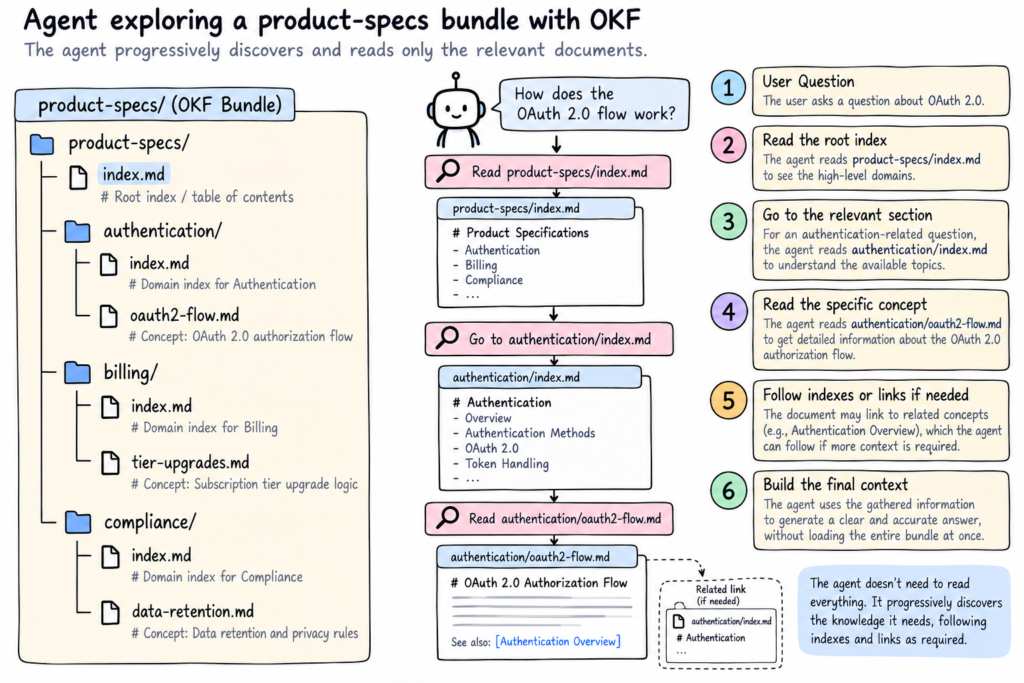
RAG and OKF
A typical retrieval flow might look like this:
User Question
      ↓
Vector / Hybrid Search
      ↓
Find a relevant OKF concept
      ↓
Read the concept
      ↓
Follow indexes or links when necessary
      ↓
Build the final context
OKF does not make embeddings, vector databases, or hybrid search obsolete. Instead, it can complement these technologies by providing a structured, portable format for the knowledge being retrieved.
In other words, an OKF bundle could simply become the source format behind a retrieval system.
Of course, there is nothing technically wrong with creating your own document chunks and attaching metadata such as:
{
  "title": "...",
  "source": "...",
  "type": "...",
  "updated_at": "...",
  "owner": "..."
}
That approach can work perfectly well.
The difference is that this metadata structure is your convention.
Another producer might use different fields or represent the same information differently. A different consumer may then need custom translation logic to understand it.
That is where a shared format becomes valuable.
The benefit is not necessarily another piece of technology. It is the small, predictable interoperability surface created when multiple producers and consumers agree on how knowledge should be represented and exchanged.
What about Agent Skills?
Agent Skills and OKF can look quite similar at first glance.
Both can involve Markdown, both can be packaged as files, and both can influence what an agent is able to accomplish.
The distinction I find useful is:
A Skill primarily tells an agent how to perform a task. OKF provides the knowledge the agent may need while performing that task.
Consider a customer-support Skill:
1. Identify the customer's issue
2. Inspect the order status
3. Check the applicable refund policy
4. Determine whether escalation is required
5. Draft a response
The Skill does not necessarily need to contain every product rule, business policy, and refund condition in one large instruction file.
Instead, it could reference a knowledge bundle:
customer-support-skill/
├── SKILL.md
└── references/
    └── commerce-knowledge/
        ├── index.md
        ├── orders/
        ├── payments/
        └── policies/
The Skill defines the workflow.
The OKF bundle provides the domain knowledge.
These two concepts therefore don’t need to compete with each other. In fact, they fit together quite naturally.
A Skill can tell an agent when and how to consult external knowledge, while that knowledge can have its own structure, ownership, update cycle, and lifecycle.
The OKF Use Case I Find Most Interesting Is Actually Local
The more I think about OKF, the less interesting the idea of a massive enterprise-wide knowledge platform becomes to me.
The use case I find more compelling is much simpler:
Put domain knowledge next to the project that depends on it.
Consider an e-commerce application:
storefront/
├── src/
├── tests/
├── AGENTS.md
└── knowledge/
    ├── index.md
    ├── checkout/
    ├── orders/
    ├── payments/
    ├── refunds/
    └── promotions/
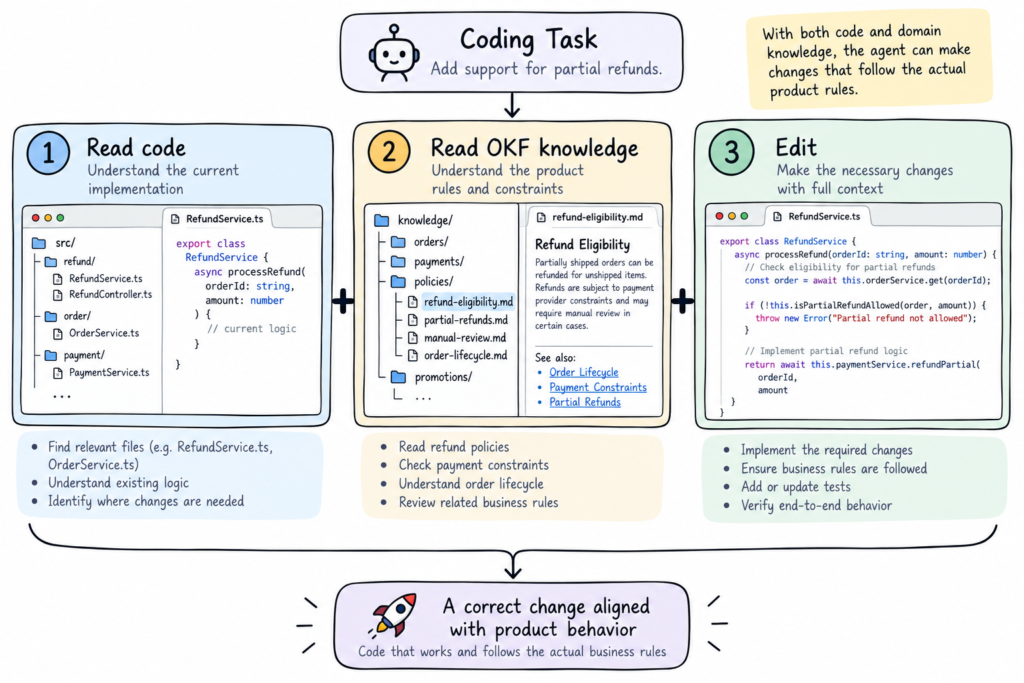
A coding agent today often works roughly like this:
Read the code
      ↓
Understand the code
      ↓
Modify the code
But production software cannot always be understood from source code alone.
Suppose the task is:
Add support for partial refunds.
Finding refundService.ts is only part of the problem.
The agent may also need to understand:
- whether partially shipped orders can be refunded
- whether promotions affect the refundable amount
- whether the payment provider supports partial refunds
- when manual review is required
- what happens to loyalty points after a refund
Those rules may not be clearly expressed in the implementation itself.
They are business and product knowledge.
And that is where I think a structured knowledge format becomes particularly interesting: the knowledge required to modify a system can live alongside the system itself, rather than being hidden in someone’s memory, scattered across tickets and documents, or embedded implicitly in the code.
The result is a project where an agent can discover not only how the software works, but also why it works the way it does.
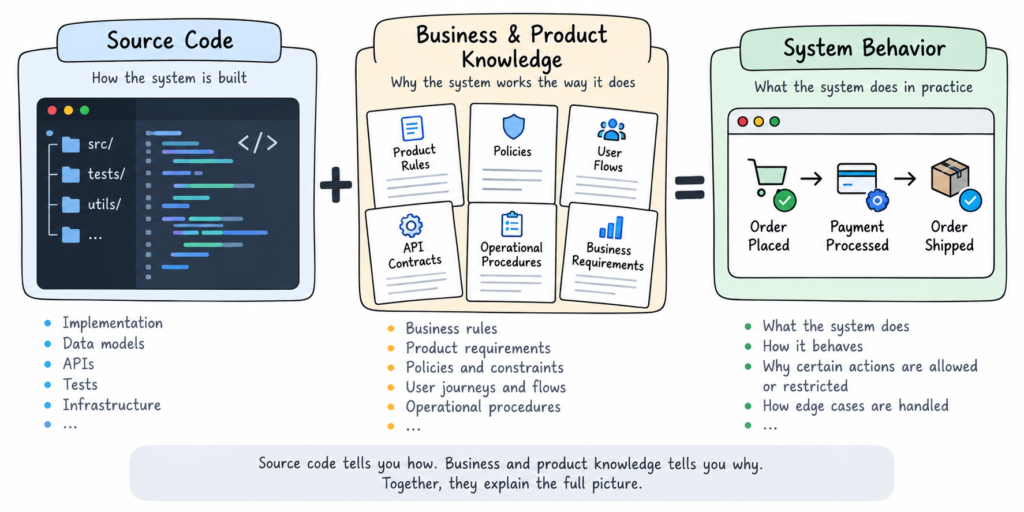
If a coding agent only has access to the source code, it may be seeing only part of the system.
The implementation can tell the agent how the software is built, but it may not fully explain the business rules, product decisions, or operational constraints behind that implementation.
Now imagine the project also contains a small, structured, and explorable knowledge bundle.
The agent can then approach a coding task more like this:
Coding Task
     ↓
Read the relevant code
     +
Read the refund policy
     +
Read payment constraints
     +
Read the order lifecycle
     ↓
Understand the actual product behavior
     ↓
Modify the code
The important difference is that the agent is no longer relying on source code alone.
It can combine implementation details with the domain knowledge that explains why the system behaves the way it does.
This can help the agent make changes with the broader product context in mind, rather than treating each code change as an isolated programming task.
That leads to another interesting possibility.
What happens when the implementation and the product rules evolve together?
Sometimes a developer isn’t just implementing an existing rule—the code change actually introduces or modifies the rule itself.
In that case, the knowledge should evolve alongside the implementation.
The workflow could look like this:
Modify the code
       ↓
Product behavior changes
       ↓
Update the corresponding knowledge
       ↓
Code and domain knowledge stay aligned
For example, suppose the business decides that customers can now request partial refunds for partially shipped orders.
The developer may need to update both:
src/refund/RefundService.tsand:
knowledge/policies/partial-refunds.mdThe code implements the new behavior, while the knowledge documents the rule that explains why that behavior exists and under what conditions it applies.
This creates an important relationship between the two:
Source Code
     ↕
Product & Business Knowledge
The goal isn’t to duplicate the implementation in documentation. It’s to keep the executable behavior and the domain knowledge that explains that behavior aligned.
That could become especially useful for coding agents: when a future agent encounters the same area of the system, it can inspect both the implementation and the updated product knowledge rather than relying on outdated assumptions.
The knowledge is no longer just documentation that someone writes once and eventually forgets about.
Instead, it can potentially evolve alongside the project.
It is important to clarify that this workflow is not part of the OKF specification. It is simply one direction that I find worth exploring after spending time with the format.
I also suspect that small, project-local knowledge bundles could be one of the simplest ways to get practical value from the idea.
Rather than starting with:
“Let’s build the company’s universal AI knowledge platform.”
you can start with a much smaller question:
“What knowledge does an engineer—or a coding agent—need to work safely and effectively on this repository?”
That is a much smaller problem, and probably a much easier one to solve incrementally.
Local and Central Knowledge Don’t Have to Compete
Project-local knowledge does not eliminate the need for organization-wide knowledge.
Some information naturally belongs at the organizational level:
Company terminology
Shared authentication rules
Common API contracts
Billing definitions
Customer policies
Security guidelines
So I can imagine an agent working with both local and central knowledge:
                    Agent
                   /     \
                  /       \
                 ↓         ↓
           Local OKF    Central OKF
           project       shared
           knowledge     knowledge
The local bundle answers:
“What do I need to know to work on this project?”
The central layer answers:
“What knowledge should be discoverable across the organization?”
How that central layer is implemented is a separate architectural decision.
It could use Git, object storage, a metadata index, full-text search, vector search, or even expose resources through MCP.
None of those choices are required by OKF itself.
I find it useful to separate these layers:
OKF
= Knowledge Artifact
MCP
= Serving / Tool ProtocolSearch Index
= Retrieval ImplementationThey solve different problems.
The infrastructure used to serve or retrieve the knowledge can change over time without necessarily requiring the underlying knowledge artifacts to change with it.
For example, an organization could move from one search platform to another while continuing to use the same OKF knowledge bundle.
That separation is valuable.
v0.2 Makes the Model More Complete
OKF v0.1 was intentionally small.
It focused on a simple foundation:
- Markdown
- YAML frontmatter
- A small set of conventions
That simplicity was part of the appeal.
But once agents start creating, updating, and maintaining knowledge themselves, another question becomes important:
Why should another agent trust a particular piece of knowledge?
Imagine two concepts describing the same refund policy.
One was generated yesterday from the current policy source and reviewed by a human.
The other was generated six months ago, with no clear indication of whether the underlying policy has changed.
A consumer should be able to distinguish between those two concepts.
This is where OKF v0.2 becomes particularly interesting.
The updated specification introduces concepts around provenance, trust, freshness, lifecycle, and attestation.
A concept can carry information such as:
sources:
  ...

generated:
  by: ...
  at: ...

verified:
  ...

status: stable

stale_after: 2026-12-31
This gives a consumer useful context before it even reads the full Markdown document:
Where did this knowledge come from?

Who generated it?

Has it been verified?

Is it still current?

Is it a draft or a stable concept?
That becomes increasingly important as machines begin generating and maintaining a larger portion of an organization’s knowledge.
At the same time, OKF keeps the basic requirement small.
In v0.2, type remains the only frontmatter field that is always required. Producers can add provenance, trust, and lifecycle information when they need it without forcing every concept into a large, rigid schema.
That balance between minimal structure and optional metadata is one of the aspects I find appealing about the design.
Attested Computation Is a Different Kind of Knowledge
v0.2 also introduces a concept that I initially wouldn’t have associated with a Markdown-based knowledge format:
Attested Computation.
Sometimes what an agent needs to know isn’t simply:
“The refund rate last month was 4.8%.”
The more valuable piece of knowledge may actually be:
“This is the approved method for calculating the refund rate.”
Consider a business metric that must always be calculated using a specific query or deterministic procedure.
You probably don’t want an agent improvising a slightly different SQL query every time someone asks for that metric.
An Attested Computation can describe an approved computation, how it should be executed, and how its resulting receipt can be verified deterministically.
This expands the role of a knowledge artifact.
It doesn’t only say:
Here is something we know.It can also describe:
Here is the approved way
to establish that something is true.
I think this points toward a broader challenge.
If agents are eventually going to create, update, exchange, and act on organizational knowledge, then knowledge needs more than content.
It also needs signals about where that knowledge came from, how current it is, and why another system or agent should trust it.
So What Problem Does OKF Actually Solve?
After spending time with the idea, I wouldn’t describe OKF as “the next generation of RAG.”
I wouldn’t describe it as a new knowledge database either.
And OKF itself isn’t an enterprise knowledge architecture.
The way I currently think about these pieces is:
RAG is primarily about retrieval.
Skills are primarily about agent behavior and workflows.
MCP is primarily about exposing capabilities and resources to agents.
OKF addresses a different, more fundamental question:
How should knowledge be packaged so that humans, agents, tools, and systems can exchange it without every consumer having to invent its own format?
That distinction is important.
Standards aren’t always valuable because they make something previously impossible.
Sometimes their value comes from turning something that everyone is already doing independently into a shared convention.
We already had Markdown.
We already had YAML frontmatter.
We already had Git.
And navigating documentation through indexes and links is certainly not a new idea.
What makes OKF interesting is the possibility that these simple building blocks can become a common boundary between knowledge producers and consumers.
A product team could publish a knowledge bundle.
A support agent could consume it.
A coding agent could use the same bundle while implementing a feature.
A search system could index it.
A human engineer could open the same files and read them directly.
And if the platform serving that knowledge changes later, the underlying knowledge artifact doesn’t necessarily have to disappear or be rebuilt from scratch.
That is what I currently find most compelling about OKF.
It isn’t particularly flashy.
Open an OKF bundle and, at first glance, you’re still looking at a directory containing Markdown files.
But that simplicity may actually be one of its strengths.
The interesting part isn’t the files themselves. It’s the possibility of making those files a shared, portable boundary between the people and systems that create knowledge and the agents and applications that consume it.
For teams adopting this pattern, Open Knowledge Format works best when it is treated as a living project asset. Open Knowledge Format should describe the concepts an agent must understand before acting, and Open Knowledge Format should stay close to the systems it explains. A small Open Knowledge Format bundle can begin with one workflow, one policy area, or one product surface. As the team learns, Open Knowledge Format can expand into shared terminology, verified references, operational notes, and reusable examples. The goal is not to mention Open Knowledge Format everywhere; the goal is to make Open Knowledge Format useful enough that humans and agents can rely on Open Knowledge Format as a consistent knowledge boundary.
Open Knowledge Format also fits several fast-growing AI search themes: agentic AI, AI agents, RAG, enterprise search, knowledge graphs, MCP, AI search visibility, agentic SEO, AI-ready content, and enterprise AI governance. For teams trying to make content useful to both humans and agents, Open Knowledge Format provides a practical structure for AI knowledge management.
Open Knowledge Format can support retrieval augmented generation, semantic search, hybrid search, and agentic workflows without forcing every team into one platform. Open Knowledge Format is especially relevant as AI agents, MCP servers, and enterprise RAG systems need trusted context instead of scattered documents.
A well-maintained Open Knowledge Format bundle can become the bridge between search visibility, agent optimization, and reliable enterprise AI. In that sense, Open Knowledge Format is not just a documentation pattern; Open Knowledge Format is an AI-ready knowledge layer for teams building with AI agents, RAG pipelines, MCP tools, and knowledge graph style navigation.
Open Knowledge Format helps make organizational context searchable, portable, and easier for agentic AI systems to trust. Open Knowledge Format also gives teams a clearer way to align AI search visibility, enterprise RAG, and AI knowledge management around one shared knowledge artifact.
For practical adoption, Open Knowledge Format should stay readable, Open Knowledge Format should stay versioned, and Open Knowledge Format should stay useful for both people and AI agents.
When NOT to use Open Knowledge Format
Do not use Open Knowledge Format for a one-off prompt, a temporary note, or a small personal checklist that no other human or agent needs to reuse.
Do not use Open Knowledge Format when a strict domain schema already solves the problem better, such as OpenAPI for API contracts, Protobuf for serialization, or a formal database schema for transactional systems.
Do not use Open Knowledge Format as a replacement for RAG infrastructure, vector search, MCP servers, or governance systems. Open Knowledge Format is best understood as a portable knowledge artifact, not the entire serving architecture.
Primary sources
Official Google Cloud introduction to Open Knowledge Format: https://cloud.google.com/blog/products/data-analytics/how-the-open-knowledge-format-can-improve-data-sharing
Official Open Knowledge Format GitHub repository: https://github.com/GoogleCloudPlatform/open-knowledge-format
Open Knowledge Format v0.2 source/specification material: https://github.com/GoogleCloudPlatform/open-knowledge-format/blob/main/SPEC.md
Google Cloud update on OKF v0.2 trust signals: https://cloud.google.com/blog/products/data-analytics/okf-v0-2-adds-trust-signals/
FAQs
What is Open Knowledge Format?
Open Knowledge Format is a portable way to represent knowledge for humans, tools, and AI agents using readable Markdown, frontmatter, links, and conventions that make context easier to exchange.
Is Open Knowledge Format the same as RAG?
No. RAG is a retrieval architecture, while Open Knowledge Format describes how the knowledge itself can be packaged, structured, reviewed, and exchanged. A RAG system can index an Open Knowledge Format bundle, but the two solve different layers of the problem.
Does Open Knowledge Format replace MCP?
No. MCP exposes tools, prompts, and resources to agents. Open Knowledge Format can provide portable knowledge artifacts that an MCP server, search index, or agent workflow may expose or consume.
Who should use Open Knowledge Format?
Open Knowledge Format is most useful for teams that need reusable, versioned, inspectable knowledge for AI agents, enterprise RAG systems, coding agents, internal documentation, and cross-tool knowledge exchange.
What is the biggest benefit of Open Knowledge Format?
The biggest benefit is portability. Open Knowledge Format lets producers and consumers share structured context without forcing every team to adopt the same database, SaaS product, agent framework, or retrieval engine.
How should a team start with Open Knowledge Format?
Start with one narrow, high-value domain. A small Open Knowledge Format bundle for a policy area, product surface, or coding-agent workflow is easier to review, maintain, and trust than a broad enterprise-wide rollout.
