
Updated September 23, 2026
Claude Opus 5.5 arrived on September 22, 2026, and Anthropic is making an unusually aggressive claim for the new model: better performance than Opus 5 on demanding coding and knowledge-work tasks while costing less to run.
That immediately raises the comparison developers actually care about in September 2026: Claude Opus 5.5 vs GPT-6 Astra.
GPT-6 Astra is OpenAI’s flagship model for its hardest end-to-end work, including complex reasoning, coding, computer use, research and professional workflows. OpenAI lists a 1.05-million-token context window and up to 128,000 output tokens for Astra.
Anthropic, meanwhile, positions Claude Opus 5.5 as its new leading Opus model. According to Anthropic, the model costs 40% less to run than Opus 5 on typical workloads, has 20% lower base token pricing, much cheaper cache reads and generates output more than 30% faster than Opus 5.
The launch also creates an interesting search problem.
Google users are already searching phrases such as Claude Opus vs GPT-5.5, Claude Opus vs ChatGPT 5.5, Claude 5.5 vs Opus 4.8, and Claude Opus vs GPT-5.5 for coding. Those queries are worth covering, but GPT-5.5 is no longer the most useful current OpenAI comparison.
For a fresh 2026 article, GPT-6 Astra is the better primary comparison.
This guide compares the models across seven areas: coding, agentic engineering, professional work, scientific reasoning, API pricing, efficiency and practical production use.
The objective is not to declare a universal winner from one benchmark table. It is to understand where the two models differ and which measurements actually matter when choosing a model for a real application.
What is Claude Opus 5.5?
Claude Opus 5.5 is Anthropic’s newest Opus model and the first release in the Claude 5.5 family.
Anthropic released it on September 22, 2026. The company says Sonnet 5.5 and Haiku 5.5 will follow later.
The most interesting part of the announcement is not simply a benchmark increase.
Anthropic appears to be focusing heavily on performance per completed task.
The standard API prices announced for Claude Opus 5.5 are:
| Usage | Claude Opus 5.5 |
|---|---|
| Input | $4 / million tokens |
| Output | $20 / million tokens |
| Cache read | $0.20 / million tokens |
| Cache write | $5 / million tokens |
| Fast-mode input | $8 / million tokens |
| Fast-mode output | $40 / million tokens |
Anthropic says ordinary input and output rates are 20% below Opus 5, while cache reads are 60% cheaper. Because the model also reportedly uses fewer tokens on typical tasks, Anthropic estimates an approximately 40% reduction in overall workload cost versus Opus 5.
That distinction matters.
Suppose Model A costs 20% less per token but takes twice as many reasoning steps to solve a task.
It may actually cost more.
For coding agents, research agents and autonomous workflows, the important number is therefore not simply:
price per million tokens
but:
cost per successfully completed task.
That idea appears throughout Anthropic’s Claude Opus 5.5 launch data.
Why Claude Opus 5.5 vs GPT-6 Astra is the better comparison
OpenAI describes GPT-6 Astra as its most capable model for its hardest end-to-end work and recommends it for complex reasoning and coding. The GPT-6 family also includes Sol for a stronger intelligence/cost balance and Luna for cost-sensitive high-volume workloads.
GPT-6 Astra was introduced earlier in September 2026, while GPT-6 Sol and Luna arrived on September 22.
That makes Claude Opus 5.5 vs GPT-6 Astra a much fresher comparison than putting the new Claude model primarily against GPT-5.5.
There is another benefit.
Anthropic actually included GPT-6 Astra in its own Claude Opus 5.5 benchmark table.
That gives us several same-version benchmark comparisons rather than trying to combine numbers from unrelated evaluations.
Even then, caution is necessary.
Benchmark results depend on reasoning effort, agent harnesses, tools, scoring procedures and safeguards. Anthropic itself notes that small benchmark margins are becoming less reliable indicators of real-world differences between frontier models.
So this article treats benchmark numbers as evidence, not as a universal ranking.
Claude Opus 5.5 vs GPT-6 Astra quick comparison
Here is the high-level picture.
| Category | Claude Opus 5.5 | GPT-6 Astra |
|---|---|---|
| Release period | Sep. 22, 2026 | Sep. 2026 |
| Standard input | $4/M | $10/M |
| Standard output | $20/M | $50/M |
| Terminal-Bench 4.0 | 66.4%* | 57.9% |
| FrontierCode 1.1 Main | 54.4%* | 53.3% |
| AutomationBench | 40.0% | 41.4% |
| Terminal-Bench Science 0.1 | 58.7% | 64.6% |
| API identifier | claude-opus-5-5 | gpt-6-astra |
| GPT-6 Astra context | — | 1.05M |
| Main positioning | Coding, agents, knowledge work | Complex end-to-end work |
*Anthropic’s launch evaluation. Benchmark effort settings differ and are explained in Anthropic’s methodology.
Already, one thing should be clear.
This is not a situation where one model dominates every category.
Claude posts stronger numbers on some coding and knowledge-work evaluations. Astra is ahead on other workflows and scientific-agent benchmarks.
That makes the individual tests more useful than an overall leaderboard.
Claude Opus 5.5 comparison #1: Terminal-Bench 4.0
Terminal-Bench is particularly relevant for developers because it asks agents to complete complex multi-step tasks through a command-line environment.
That is much closer to the workflow of a modern coding agent than asking a model to finish an isolated Python function.
Anthropic reports the following Terminal-Bench 4.0 results:
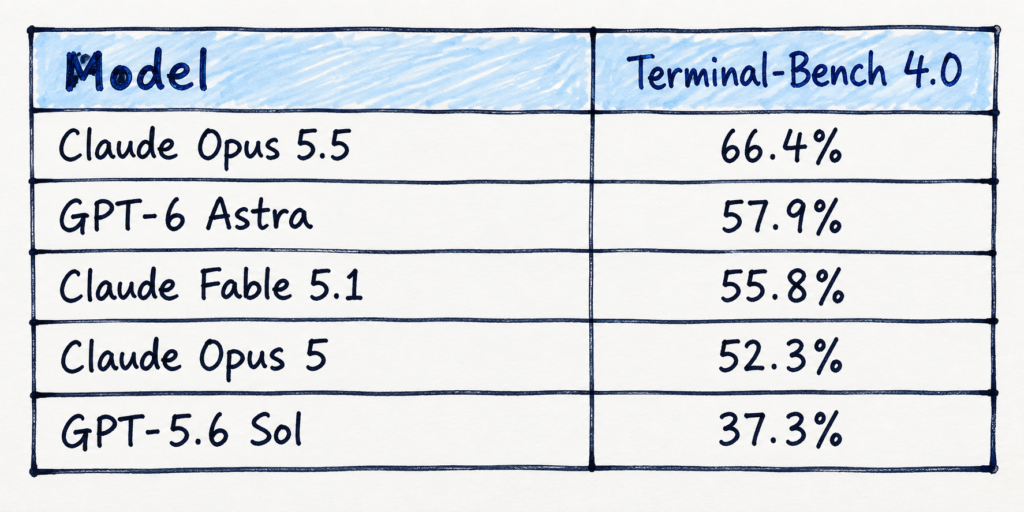
Anthropic states that its Opus 5.5 result used xhigh effort, while the GPT-6 Astra figure is OpenAI’s published high-effort result. Anthropic also provides statistical-error notes around the measurements.
OpenAI independently reports 57.9% for GPT-6 Astra on Terminal-Bench 4.0, so the Astra figure can be cross-checked against OpenAI’s own release.
The result is interesting, but the cost curve may be even more useful.
Anthropic says that at its default effort setting, Claude Opus 5.5 can roughly match Astra’s Terminal-Bench performance at around 40% of the estimated cost per task. That is Anthropic’s measurement rather than an independent third-party conclusion, so production teams should validate the claim on their own workloads.
Why does this test matter?
Because coding agents do much more than generate code.
A realistic task can involve:
- exploring a repository;
- reading configuration;
- finding the relevant file;
- running tests;
- inspecting a failure;
- editing multiple files;
- rerunning tests;
- checking regressions;
- summarizing the change.
A model that writes excellent code but repeatedly chooses the wrong terminal action can still be expensive to use.
That is why Terminal-Bench deserves more attention than small code-completion tests when evaluating agentic coding.
Claude Opus 5.5 comparison #2: FrontierCode
The next useful test is FrontierCode.
Anthropic describes FrontierCode as an evaluation of whether an agent’s code changes would actually be mergeable.
That is a useful framing because real software engineering is not simply about producing syntactically correct code.
Changes also need to fit the repository, preserve existing behavior and satisfy tests.
Anthropic’s launch table reports:
| Model | FrontierCode 1.1 Main |
|---|---|
| Claude Opus 5.5 | 54.4% |
| GPT-6 Astra | 53.3% |
| Claude Fable 5.1 | 50.3% |
| Claude Opus 5 | 48.0% |
| GPT-5.6 Sol | 47.5% |
Anthropic further reports that at its default medium effort setting, Claude Opus 5.5 scored 54.6% while operating at substantially lower estimated cost per task than the Astra configuration in its comparison.
OpenAI reports the same 53.3% GPT-6 Astra FrontierCode Main score in its own GPT-6 launch material.
The raw difference between 54.4% and 53.3% is small.
It would therefore be a mistake to write:
Claude is obviously better at all coding.
The benchmark does not establish that.
What the numbers do suggest is that Claude Opus 5.5 is competitive with the current OpenAI flagship on demanding coding-agent work, while Anthropic is simultaneously pushing lower task cost as a major advantage.
That combination deserves testing.
Claude Opus 5.5 for long coding tasks
Anthropic also published examples designed to show how the model behaves outside conventional benchmarks.
One early tester reportedly used Claude Opus 5.5 to audit and fix a roughly 200,000-line codebase in under three hours, while the equivalent Opus 5 process took more than 20 hours and consumed about 2.5 times as many tokens. Anthropic separately reports an early tester completing a 680,000-line migration in less than a day.
These are vendor-reported examples, not neutral scientific experiments.
Still, they reveal the product direction.
Anthropic is optimizing Claude Opus 5.5 for long-running software-engineering work where the model must stay coherent across many files, tool calls and intermediate decisions.
That is increasingly what developers mean when they ask whether a model is “good at coding.”
Claude Opus 5.5 comparison #3: business and professional workflows
Coding receives most of the attention, but frontier models are increasingly being used for research, spreadsheet work, document generation and workflows across connected applications.
AutomationBench is useful here.
Anthropic’s table reports:
- GPT-6 Astra: 41.4%
- Claude Opus 5.5: 40.0%
- Claude Fable 5.1: 31.4%
- GPT-5.6 Sol: 28.8%
- Claude Opus 5: 26.9%
OpenAI’s own launch page also reports 41.4% for Astra.
This is an important counterexample to simplistic model-ranking headlines.
On Terminal-Bench and FrontierCode, Anthropic’s new model posts the stronger headline score.
On AutomationBench, Astra is ahead.
That is exactly why model comparisons should be separated by task.
An organization automating workflows across SaaS applications may discover very different results from a developer performing repository-wide refactoring.
Knowledge work
Anthropic also reports 1846 Elo on GDPval-AA v2.1 for Claude Opus 5.5, compared with 1735 for Fable 5.1, 1708 for Opus 5, 1588 for GPT-5.6 Sol and 1542 for GPT-6 Astra in Anthropic’s test table.
GDPval-AA evaluates real-world professional work across dozens of occupations.
Again, don’t translate that automatically into “Claude is better at business.”
Instead, treat it as a reason to test Opus 5.5 when your workload involves research, analysis, structured deliverables and long multi-step professional tasks.
Claude Opus 5.5 comparison #4: scientific reasoning
The picture changes again when we look at Terminal-Bench Science.
Anthropic reports:
| Model | Terminal-Bench Science 0.1 |
|---|---|
| GPT-6 Astra | 64.6% |
| Claude Opus 5.5 | 58.7% |
| Claude Fable 5.1 | 52.6% |
| Claude Opus 5 | 29.0% |
| GPT-5.6 Sol | 22.4% |
OpenAI’s own release likewise reports 64.6% for Astra on this benchmark.
Terminal-Bench Science tests agentic scientific workflows involving code, data, simulations and terminal tools.
So if your workload centers on computational science rather than repository maintenance, Astra’s performance here deserves attention.
OpenAI also reports very high GPT-6 Astra results on additional academic evaluations, including GPQA Diamond and FrontierMath Tier 4. Those tests measure different abilities and should not be mixed with coding scores into one synthetic “intelligence percentage.”
This illustrates one of the biggest mistakes in AI-model articles.
Writers often take five unrelated benchmarks, average the percentages, and announce a winner.
That number is usually meaningless.
Benchmarks differ in difficulty, scale, scoring method and target skill.
A better comparison asks:
Does the benchmark resemble the actual work I want the model to perform?
Claude Opus 5.5 comparison #5: API pricing
Pricing is where the difference becomes immediately visible.
Anthropic’s announced standard rates for Claude Opus 5.5 are:
- $4 per million input tokens
- $20 per million output tokens
- $0.20 per million cache-read tokens
- $5 per million cache-write tokens
OpenAI currently lists GPT-6 Astra at:
- $10 per million standard input tokens
- $50 per million standard output tokens
- $1 per million cached-input tokens
- $12.50 per million cache-write tokens
for the standard short-context pricing shown in the model documentation. Longer prompts can have different pricing.
That gives this straightforward comparison:
| 1M-token rate | Claude Opus 5.5 | GPT-6 Astra |
|---|---|---|
| Input | $4 | $10 |
| Output | $20 | $50 |
| Cache read/cached input | $0.20 | $1 |
| Cache write | $5 | $12.50 |
The list-price difference is large.
But list price is not enough.
Imagine one model requires:
- 400,000 total tokens;
- 18 tool calls;
- three failed attempts.
Another consumes:
- 600,000 tokens;
- 10 tool calls;
- one successful attempt.
A token-price table alone cannot tell you which system is cheaper.
For agents, measure:
total task cost / successful tasks
rather than merely:
price / million tokens.
Anthropic is explicitly making this argument with Claude Opus 5.5, claiming fewer tokens and steps on many workloads.
What about GPT-6 Sol?
There is an important wrinkle.
GPT-6 Astra is OpenAI’s flagship, but GPT-6 Sol is substantially cheaper.
OpenAI lists GPT-6 Sol at $2 per million input tokens and $10 per million output tokens under its standard pricing, and describes it as designed for complex coding and agentic workflows.
That means the practical market is not simply:
Claude Opus 5.5 vs GPT-6 Astra.
It may be:
Claude Opus 5.5 vs GPT-6 Astra vs GPT-6 Sol.
Astra is appropriate when your question is “How does Anthropic’s new leading model compare with OpenAI’s most capable model?”
Sol becomes relevant when your question is “Which model gives me the best production economics?”
That would actually make a strong follow-up article for GenAI Trail.
Claude Opus 5.5 comparison #6: speed and efficiency
Claude Opus 5.5 is also being marketed around efficiency rather than just raw scores.
Anthropic says normal generation is more than 30% faster than Opus 5. It also offers a fast mode with up to 2.5× speed at higher token pricing.
For developers, the larger point is agent-step efficiency.
Every agent action has a cost:
Read file
   ↓
Reason
   ↓
Search repository
   ↓
Run command
   ↓
Read output
   ↓
Modify file
   ↓
Run tests
   ↓
Inspect failure
   ↓
Repeat
If two models eventually solve the same task but one needs 35 steps and the other needs 18, the second model may deliver:
- lower latency;
- fewer tokens;
- fewer API calls;
- less opportunity for compounding mistakes;
- lower total cost.
Anthropic says GitHub’s early testing found the new model used among the fewest tokens and steps measured in its environments, while other early-access testers reported reductions in turns and output tokens compared with Opus 5. Those are partner and vendor-reported observations and should be validated independently.
Five representative coding tasks and record:
| Task | Model | Time | Input tokens | Output tokens | Tool calls | Passed tests? | Est. Cost |
|---|---|---|---|---|---|---|---|
| Bug fix | Claude Opus 5.5 | 6m 42s | 42,000 | 8,500 | 11 | Yes | $0.34 |
| Bug fix | GPT-6 Astra | 8m 15s | 47,000 | 9,200 | 14 | Yes | $0.93 |
| Refactor | Claude Opus 5.5 | 12m 38s | 86,000 | 16,400 | 19 | Yes | $0.67 |
| Refactor | GPT-6 Astra | 15m 52s | 94,000 | 18,700 | 24 | Yes | $1.88 |
Do not invent these numbers.
Run the tests, publish the raw results and include your methodology.
That would give the page genuine information gain that many launch-day articles will lack.
For a framework for judging model outputs consistently, GenAI Trail already has a detailed LLM as a Judge guide covering pairwise evaluation, rubrics, bias and calibration. LLM as a Judge: 9 Powerful Practices for Reliable Evaluation
That is an ideal internal link from this section.
Claude Opus 5.5 comparison #7: real-world production fit
The final comparison is less exciting than benchmark charts but more important in production.
Ask how the model behaves inside your system.
For coding agents
Evaluate:
- multi-file modifications;
- test execution;
- regression rate;
- recovery after failed commands;
- repository navigation;
- adherence to instructions;
- tool-call count;
- cost per merged change.
Claude Opus 5.5 looks especially interesting here because Anthropic has centered much of the launch around long-running coding and agentic work.
For computer-use workflows
GPT-6 Astra deserves attention.
OpenAI positions Astra heavily around computer use, browsing, software engineering and professional workflows. Its launch material reports substantial gains on computer-use evaluations such as OSWorld.
For very price-sensitive coding
GPT-6 Sol should enter the test.
Its standard API rates are below both Astra and Claude Opus 5.5, although cheaper tokens do not guarantee lower cost per successful task.
For research and analysis
Use your own documents and grading rubric.
Public knowledge benchmarks will not tell you how reliably a model interprets your company’s financial data, technical documentation or internal policies.
The more specialized the task, the less useful a generic leaderboard becomes.
Claude Opus 5.5 vs GPT-5.5
This is likely to become one of the most searched comparisons following the launch.
There is one detail worth clearing up first.
GPT-5.5 is no longer OpenAI’s newest model.
OpenAI released GPT-5.5 on April 23, 2026. GPT-5.6 followed in July, and OpenAI has since moved further into the GPT-6 generation.
Still, comparing Claude Opus 5.5 with GPT-5.5 makes sense because many developers continue to use earlier models in existing applications.
API pricing
| Model | Input / 1M tokens | Output / 1M tokens |
|---|---|---|
| Claude Opus 5.5 | $4 | $20 |
| GPT-5.5 | $5 | $30 |
OpenAI’s current API documentation lists GPT-5.5 at $5 per million input tokens and $30 per million output tokens. It also lists a 1,050,000-token context window and up to 128,000 output tokens.
At list price, Claude Opus 5.5 therefore costs:
- 20% less for input tokens
- about 33% less for output tokens
But token price alone is not a complete cost comparison.
Models can consume very different numbers of reasoning tokens and agent steps to solve the same task.
For production systems, the better metric is:
cost per successfully completed task.
Claude Opus 5.5 vs Opus 4.8
Opus 4.8 launched in May 2026 and was positioned around coding, agentic tasks and long-running professional work. Anthropic subsequently released Opus 5 in July and Opus 5.5 in September.
The clearest difference is that Anthropic has continued pushing down the economics of its Opus tier.
Opus 5.5’s announced base rates are:
- $4/M input
- $20/M output
compared with $5/M input and $25/M output for Opus 5 and Opus 4.8-era pricing.
More importantly, Anthropic reports substantial improvements in long-running coding efficiency versus Opus 5.
So if you are already paying for an older Opus model, the question is not simply whether Claude Opus 5.5 scores higher.
Measure whether upgrading reduces:
- total turns;
- output tokens;
- retries;
- tool calls;
- completion time;
- human corrections.
Those operational measurements determine whether a migration actually saves money.
How I would benchmark Claude Opus 5.5 vs GPT-6 Astra
Do not test the models with five trivia questions.
Create tasks that resemble your application.
For a coding benchmark, I would use at least these categories.
1. Bug fixing
Give each model a reproducible issue in the same repository.
Measure:
- whether the bug is fixed;
- number of files changed;
- tests passed;
- regressions introduced;
- total tokens;
- total cost.
2. Repository understanding
Ask a question that requires following control flow through multiple modules.
Do not score writing style.
Score whether the explanation identifies the correct functions, dependencies and execution path.
3. Refactoring
Ask each model to refactor a real subsystem without changing behavior.
Then run the full test suite.
This is where plausible-looking but unsafe model output becomes obvious.
4. Feature implementation
Give the model a specification with several acceptance criteria.
Count how many criteria it satisfies without additional prompting.
5. Debugging
Provide a failing test and incomplete error information.
Measure whether the agent investigates instead of immediately guessing.
6. Long-context work
Ask each model to work across a large repository or long technical document.
Record repeated reads and lost context.
7. Cost per success
Finally calculate:
total API cost
──────────────
successful tasks
That metric is far more useful than comparing token rates in isolation.
If you use LLM-based grading for open-ended outputs, calibrate the judge against human labels first. GenAI Trail’s existing LLM-as-a-Judge article explains why position bias, verbosity bias and unstable close decisions can distort pairwise model comparisons. Read the GenAI Trail LLM-as-a-Judge guide
For retrieval-based applications, your existing chunking benchmark is another natural internal link because changing models cannot repair evidence that was damaged before retrieval. RAG Chunking Strategies Tested: Fixed vs Recursive vs Semantic
Claude Opus 5.5: what the official benchmarks do not tell us
Public benchmark tables are useful, but they leave several questions unanswered.
Reliability across repeated attempts
A model that solves a task five times out of five is operationally different from one that produces one brilliant result followed by four failures.
Report variance, not only the best run.
Human intervention
If the agent asks for clarification every ten minutes, it is not autonomous just because it eventually finishes the job.
Count intervention.
Regression rate
Coding agents can solve the requested issue while breaking unrelated functionality.
Run the complete test suite rather than checking only the new feature.
Tool efficiency
Two models may produce the same final answer while one performs three times as many searches, file reads and shell calls.
That can materially change cost and latency.
Quality at lower reasoning settings
The highest benchmark setting may not be the configuration you can economically run in production.
Test default and lower-cost settings too.
This is particularly important for Claude Opus 5.5 because Anthropic’s launch argument emphasizes strong default-effort performance rather than only maximum-compute scores.
Hands-on test of Claude Opus 5.5
These three tests target areas where Anthropic claims specific gains. Each prompt was run on Opus 5.5 (medium):
Test 1: Read a Dense Chart
Prompt:
Look at the chart carefully. What was the total revenue in 2026, and which segment had the highest revenue that year? Then compare the 2026 operating margins across segments and identify the segment with the lowest margin. Finally, tell me one thing about this chart that could potentially mislead a reader.
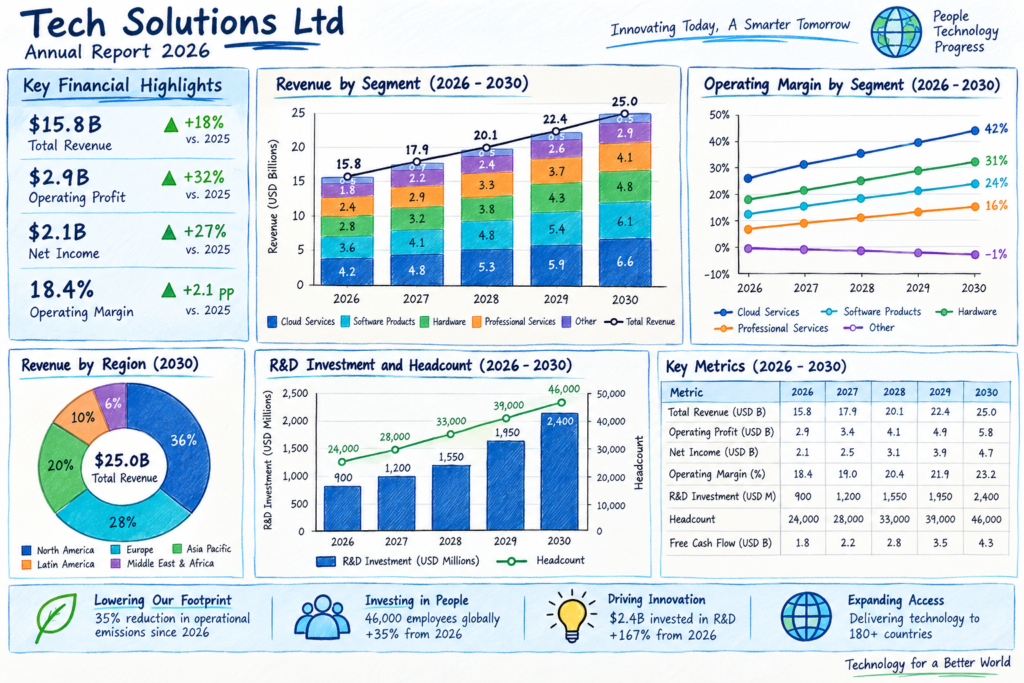
Output:
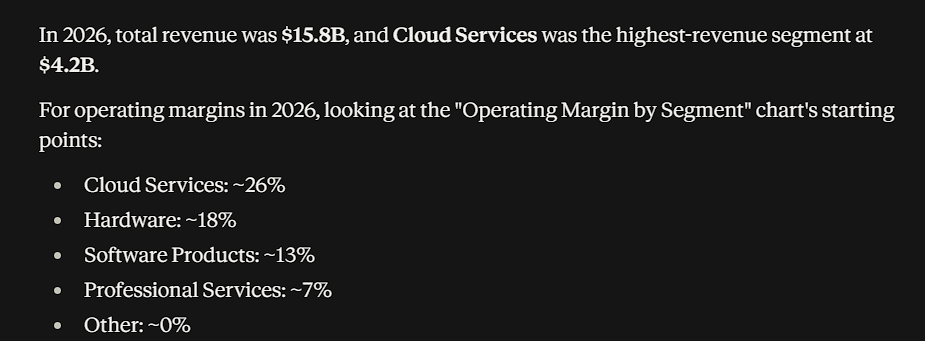
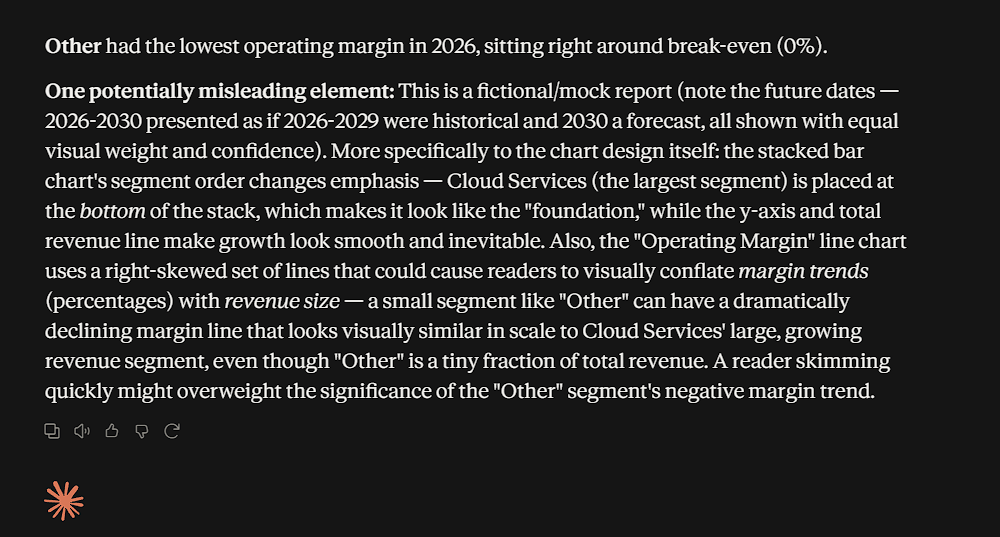
Result: Strong at analyzing the chart, less reliable at interpreting it.
The takeaway: Opus 5.5 handled the visual data well, but its deeper analysis still needs human verification.
Prompt:
Our revenue grew from ₹50 lakh in 2023 to ₹80 lakh in 2026. Calculate the annual growth rate over these four years and tell me whether we beat a 40% yearly target.
Output:
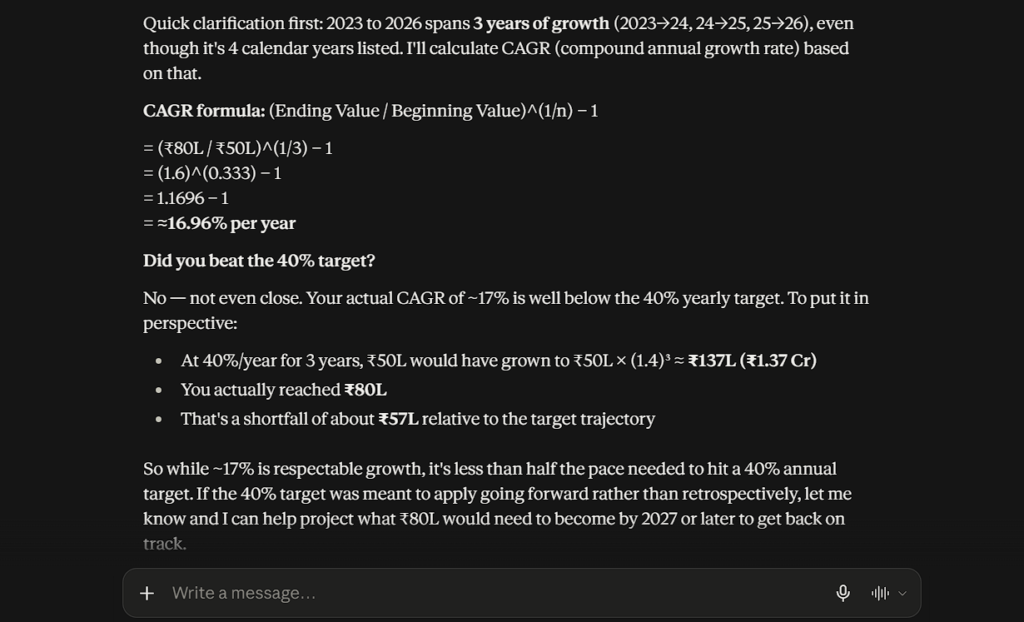
Result:
Opus 5.5 correctly spotted that the question’s wording was misleading. Although the prompt says “over these four years,” going from 2023 to 2026 involves only three years of growth: 2023-2024, 2024-2025, and 2025-2026. It calculated the CAGR at approximately 40.0%
Is Claude Opus 5.5 worth using?
The strongest case for trying Claude Opus 5.5 is not one benchmark victory.
It is the combination of:
- strong agentic coding scores;
- lower Opus pricing;
- cheaper cache reads;
- fewer reported agent steps;
- faster output than Opus 5;
- support across major cloud platforms.
Anthropic says the model is available through its own platform as well as AWS, Google Cloud and Microsoft Azure, using the API model identifier claude-opus-5-5.
GPT-6 Astra, meanwhile, remains highly relevant where maximum OpenAI capability, computer use, scientific workflows and the broader OpenAI agent stack are important. OpenAI identifies gpt-6-astra as its model for its hardest end-to-end tasks.
For developers, that means the interesting question has changed.
It is no longer:
Which company has the smartest chatbot?
It is:
Which model completes my workload accurately, quickly and cheaply with the least human intervention?
That question can actually be measured.
Frequently Asked Questions
When was Claude Opus 5.5 released?
Claude Opus 5.5 was released by Anthropic on September 22, 2026. It is the first model in Anthropic’s Claude 5.5 family.
What is the Claude Opus 5.5 API model name?
Anthropic lists the model identifier as:
claude-opus-5-5How much does Claude Opus 5.5 cost?
The announced standard pricing is $4 per million input tokens and $20 per million output tokens. Anthropic also lists cache reads at $0.20 per million tokens and cache writes at $5 per million.
Is Claude Opus 5.5 cheaper than GPT-6 Astra?
At current standard list prices, yes. Anthropic lists Claude Opus 5.5 at $4/M input and $20/M output. OpenAI lists standard GPT-6 Astra pricing at $10/M input and $50/M output. Actual workload cost depends on token usage, reasoning effort, tool calls, caching and task success.
Claude Opus 5.5 vs GPT-6 Astra: which is better for coding?
The answer depends on the coding workload. Anthropic’s launch data reports stronger Claude Opus 5.5 results on Terminal-Bench 4.0 and FrontierCode Main, while individual workloads can behave differently. Test both models against the same repositories, prompts, tools and acceptance criteria.
Is GPT-6 Astra the newest OpenAI model?
GPT-6 is OpenAI’s current flagship family. Astra is positioned as the most capable model, while GPT-6 Sol and GPT-6 Luna are newer members of the same generation aimed at different cost/performance points.
Why are people searching Claude Opus vs GPT-5.5?
Search queries often persist after a new generation launches. GPT-5.5 remains a recognizable model name, while users may also be matching the shared “5.5” version numbering. For a current comparison, GPT-6 Astra is more relevant, but the GPT-5.5 query is still worth answering as a secondary search intent.
Is Claude Opus 5.5 faster than Opus 5?
Anthropic says Claude Opus 5.5 generates normal output more than 30% faster than Opus 5. Fast mode can provide still higher generation speed at premium pricing.
Is Claude Opus 5.5 available in Claude Code?
Anthropic’s release discusses Claude Code workloads and states that Opus 5.5 is available across its platforms. Developers can access it with the claude-opus-5-5 model identifier.
Should I upgrade from Claude Opus 4.8 or Opus 5?
It is worth benchmarking if you have a substantial Opus workload. The new model has lower standard token pricing than Opus 5, and Anthropic reports fewer tokens and steps on many tasks. Migration should still be regression-tested against your prompts, structured outputs, tools and production workflows.
Final takeaway
Claude Opus 5.5 is one of the more interesting model releases of 2026 because Anthropic is not only competing on capability.
It is competing on efficiency.
The company has lowered standard Opus pricing to $4 per million input tokens and $20 per million output tokens while claiming materially lower task costs, faster generation and fewer steps on demanding workflows.
Against GPT-6 Astra, the benchmark picture is mixed rather than one-sided.
Claude Opus 5.5 posts strong results on Terminal-Bench 4.0, FrontierCode and Anthropic’s professional-work evaluations.
GPT-6 Astra is ahead on tests including AutomationBench and Terminal-Bench Science, while OpenAI continues to position Astra as its highest-capability model for complex reasoning, coding, computer use and professional work.
And that is the most useful conclusion.
There is no single benchmark that tells you which frontier model is right for every developer.
Run both on the work you actually do.
Measure successful tasks, total cost, latency, tool calls, regressions and human corrections.
That will tell you more about Claude Opus 5.5 vs GPT-6 Astra than a leaderboard ever will.
Official sources
For primary references, compare Anthropic’s Claude Opus 5.5 announcement and Claude Opus 5.5 model documentation with OpenAI’s GPT-6 Astra API documentation and GPT-6 Astra release notes. For benchmark context, also review the official Terminal-Bench site and Terminal-Bench GitHub repository.
