
GLM-5.3 is Z.ai’s current flagship: a 753-billion-parameter mixture-of-experts model with a one-million-token context window, priced at $1.40 per million input tokens and $4.40 per million output. It is strong at coding and agentic work, and there are two things about its cost that the rate card does not tell you.
Everything below comes from Z.ai’s own documentation and model card. Where sources disagree, I say so instead of picking whichever number reads better.
| Total parameters | 753B |
| Architecture | Mixture of experts with DSA (glm_moe_dsa), same family as GLM-5.2 |
| Context window | 1M tokens via the API |
| Max output | 128K tokens |
| Inputs | Text only — no image input |
| Reasoning | Always on. Effort levels low, high, max (default max) |
| API model name | glm-5.3 |
| Tensor types | BF16, F8_E4M3, F32 |
One inconsistency worth flagging: Z.ai’s API docs state a 1M-token context window, while the model card’s evaluation footnotes reference 300K. The most likely reading is that the API serves 1M and the published benchmarks were run at 300K. If you are designing around very long contexts, verify against your own account rather than trusting either figure.
The pricing ladder most articles miss
Coverage of GLM-5.3 quotes $1.40/$4.40 and stops there. But Z.ai publishes a whole ladder, and the cheaper rungs are where most workloads should actually sit.
| Model | Input /1M | Cached input /1M | Output /1M |
|---|---|---|---|
| GLM-5.3 | $1.40 | $0.26 | $4.40 |
| GLM-5.3-Flash | $0.15 | $0.03 | $0.50 |
| GLM-4.7-FlashX | $0.07 | $0.01 | $0.40 |
| GLM-4.7-Flash / GLM-4.5-Flash | Free | Free | Free |
| GLM-4.6V-Flash / GLM-4.5V-Flash (vision) | Free | Free | Free |
GLM-5.3-Flash costs roughly a tenth of GLM-5.3. Cached input storage is currently free across the paid models. And there are genuinely free tiers, including free vision models — which matters because GLM-5.3 itself cannot accept images at all.
Two things that raise your real bill
This is the part I would want to know before committing, and it is not on the pricing page.
Reasoning is always on, and defaults to maximum effort. Z.ai’s docs state the model requires reasoning, with three levels — low, high and max — and max is the default. Reasoning tokens are output tokens. Leave the default in place and you are billing every request at the most expensive setting the model offers.
It is more verbose than its predecessor. Artificial Analysis found GLM-5.3 produces longer responses than GLM-5.2 despite identical per-token pricing. Per-token parity does not mean per-task parity: the same job costs more because it emits more tokens.
Put those together and the practical advice is straightforward. Benchmark your own workload at low and high before accepting max, and measure cost per completed task rather than per token. On an output-heavy workload at $4.40 per million, the gap between effort settings is likely the largest single lever you have.
What it actually costs
Worked example at the defaults above — 50M input tokens a month at a 70% cache hit rate, plus 5M output. GLM-5.3 comes to $52.10. GLM-5.3-Flash does the same volume for $5.80, and DeepSeek V4.1 Flash for $5.36. The flagship is about 9.7× the cost of either Flash-tier option.
That multiple is the whole decision. GLM-5.3 has to be roughly ten times more valuable on your tasks to justify itself over its own Flash variant, and the only way to know is to measure. The same reasoning applies across providers — our guide to cutting LLM API costs covers the caching and routing patterns that make a tiered setup work.
One thing the calculator makes visible that no rate card does: which Flash-tier model is cheaper depends entirely on your cache hit rate. With no caching, GLM-5.3-Flash wins at $10.00 against DeepSeek’s $10.50, because its output rate is $0.50 against $0.60. Push the cache hit rate to 100% and it inverts — DeepSeek drops to $3.15 while GLM-5.3-Flash sits at $4.00, because DeepSeek’s cached input costs $0.003 per million against GLM’s $0.03, a tenfold difference. Output-heavy work with little reusable context favours GLM; context-heavy agent loops favour DeepSeek. Try both numbers above before you assume either is simply cheaper.
GLM-5.3 against DeepSeek V4.1 Flash
These two launched days apart and target similar work, so a comparison is fair. Two benchmarks appear in both vendors’ published results, which lets us compare like with like rather than across different evaluation setups.
| Benchmark | GLM-5.3 | DeepSeek V4.1 Flash |
|---|---|---|
| Terminal Bench 2.1 | 88.2 | 90.6 |
| DeepSWE v1.1 | 66.9 | 74.2 |
On these two, DeepSeek leads — and at roughly a tenth of GLM-5.3’s price. Two caveats before you read too much into it: both sets are vendor-reported, and each vendor picked which benchmarks to publish. GLM-5.3 also posts strong results on evaluations DeepSeek does not report, including CyberGym at 84.5 and Toolathlon Verified at 73.0.
The other real difference is multimodality. DeepSeek V4.1 Flash accepts images natively; GLM-5.3 is text-only. If your pipeline handles screenshots or documents, that decides it before price does. Full pricing and specs in our DeepSeek V4.1 Flash cost guide.
I ran GLM-5.3 on ten developer tasks
Vendor benchmarks tell you how a model does on vendor benchmarks. I wanted to know what it is like to actually use, so I ran ten ordinary developer tasks through it and measured what came back: an off-by-one bug, a Postgres aggregation, a bounded date regex, a FastAPI endpoint, a production Dockerfile, a pytest suite, a refactor, a binary search, a SQL-injection review and a concurrency bug.
Each task had a pass criterion written before the run. Where the output was executable, I ran it rather than reading it.
| Task | Latency | Out tokens | Tokens/s | Attempts | Result |
|---|---|---|---|---|---|
| 01 off-by-one fix | 8.35s | 207 | 24.8 | 1 | Pass |
| 02 Postgres query | 3.15s | 175 | 55.6 | 1 | Pass |
| 03 date regex | 15.91s | 666 | 41.9 | 1 | Pass |
| 04 FastAPI endpoint | 10.03s | 337 | 33.6 | 1 | Pass |
| 05 Dockerfile | 169.34s | 8,595 | 50.8 | 2 | Pass |
| 06 pytest suite | 123.83s | 9,346 | 75.5 | 1 | Pass |
| 07 refactor | 18.76s | 1,325 | 70.6 | 3 | Pass |
| 08 binary search | 9.57s | 407 | 42.5 | 1 | Pass |
| 09 SQL injection review | 25.14s | 1,223 | 48.7 | 3 | Pass |
| 10 concurrency bug | 24.81s | 1,016 | 41 | 1 | Pass |
All ten passed. Four produced runnable code, and all four survived execution: the off-by-one fix matched items[-n:] across every case I tried, the regex correctly accepted 01–12 and 01–31 while rejecting 2025-13-01 and 2025-00-10, the refactor was behaviourally identical to the original across 2,000 randomised inputs, and the binary search matched a brute-force reference across 3,000 randomised sorted lists.
The quality showed in the caveats it volunteered rather than the code alone. It noted unprompted that its own regex still matches 2025-02-30 because range validation is not calendar validation, that EmailStr needs the email-validator package, and that Kubernetes ignores Docker HEALTHCHECK directives. Those are the remarks of something that has read a lot of production post-mortems.
The finding that actually matters: it will not shut up
Ten prompts totalling 999 input tokens produced 23,297 output tokens. That is a 23× amplification, and on a model priced at $4.40 per million output against $1.40 input, output is where essentially your whole bill lives.
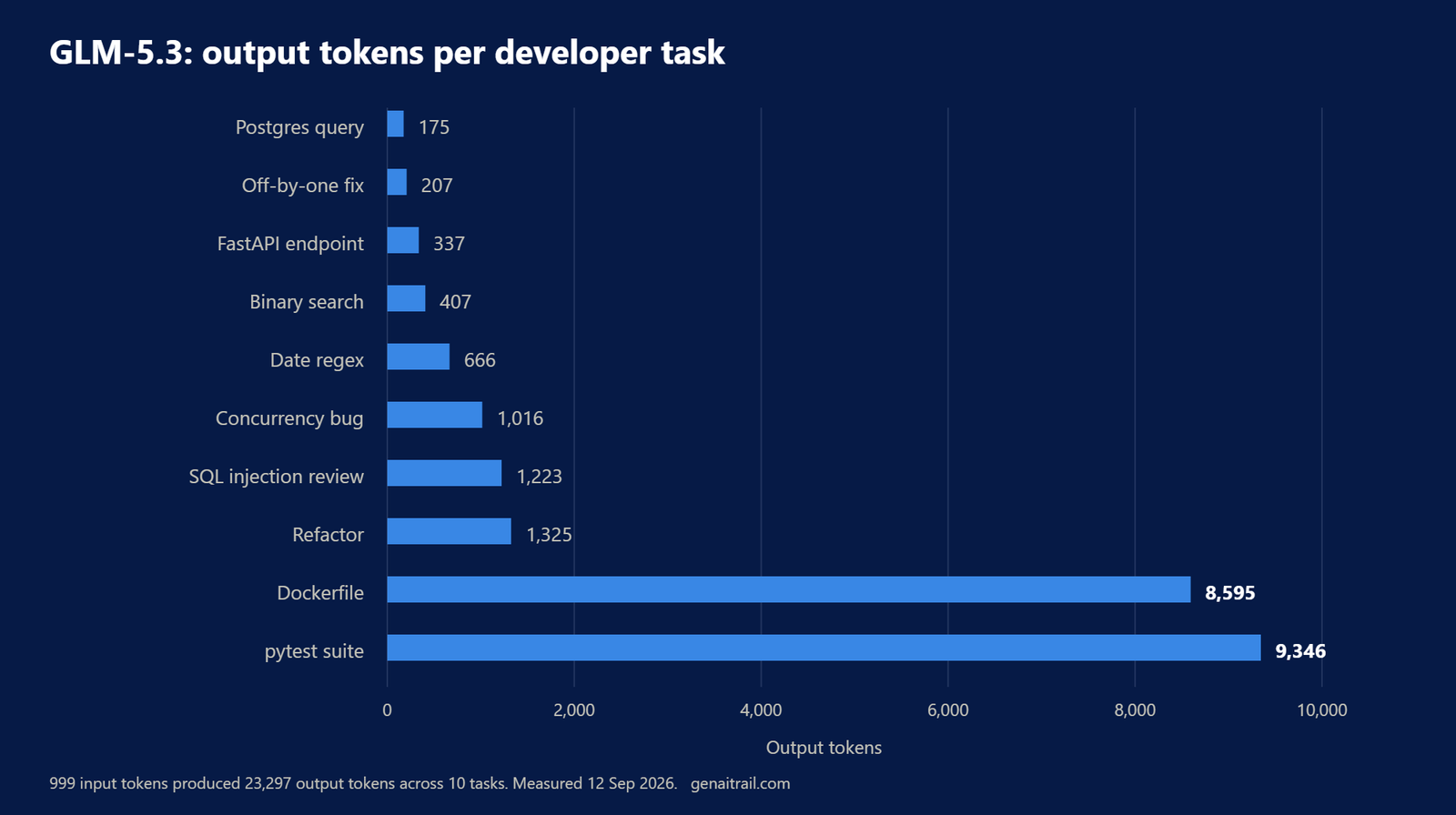
The spread is the striking part: 175 tokens for the SQL query, 9,346 for the pytest suite. A 53× range from prompts that were all roughly the same size. Asked for a Dockerfile, it returned 8,595 tokens — the Dockerfile, plus a .dockerignore, a health check, and four paragraphs of deployment notes. Excellent work, and far more than was asked for.
This is the verbosity Artificial Analysis flagged, showing up as a measurable cost. It also drives latency: the whole run took 6 minutes 49 seconds, and those two long tasks accounted for 71.7% of it. Throughput varied from 24.8 to 75.5 tokens per second, and counterintuitively the shortest answers had the worst rate — consistent with a fixed startup cost per request that short responses cannot amortise.
What the run would have cost
| Model | 10 tasks | Per task |
|---|---|---|
| GLM-5.3 | $0.1039 | $0.0104 |
| GLM-5.3-Flash | $0.0118 | $0.0012 |
| DeepSeek V4.1 Flash (off-peak) | $0.0141 | $0.0014 |
About a penny per task on the flagship, and roughly 8.8× less on either Flash tier. Scale that to an agent making thousands of calls a day and the multiple stops being academic. Note too that the amplification means the effort setting is the dominant lever — reasoning tokens are billed as output, and this run used whatever the endpoint defaults to.
What this test does not tell you
Being straight about the limits, because a test you cannot poke holes in is usually a test that was not run.
- Ten out of ten means the test was too easy. These are competent-mid-level tasks, and the model cleared them all, so this run cannot rank GLM-5.3 against anything at the top end. It establishes a floor, not a ceiling.
- It ran through a third-party free endpoint, not Z.ai directly. Quantisation, routing and default reasoning effort may all differ from the official API. Treat the numbers as indicative of that endpoint on that day.
- Three tasks needed retries (the Dockerfile twice, the refactor and the security review three times each). That is free-tier throttling, and it says nothing about the model.
- One run, one prompt each, no repeats. Latency in particular would move about on a rerun.
- No control model. I did not run the same ten tasks against DeepSeek or anything else under identical conditions, so the cost table compares prices, not quality.
The honest summary: GLM-5.3 handled everything competently and thoroughly, and its thoroughness is exactly what you pay for. If you are billing output tokens, measure your own workload before assuming the headline rate is what you will spend.
Published benchmarks
| Benchmark | Score |
|---|---|
| Terminal Bench 2.1 | 88.2 |
| Terminal Bench 3.0 | 28.3 |
| DeepSWE v1.1 | 66.9 |
| CyberGym | 84.5 |
| Toolathlon Verified | 73.0 |
| AutomationBench v1.0.6 | 48.2 |
The Terminal Bench pair is worth pausing on: 88.2 on version 2.1 against 28.3 on 3.0. That is not a defect in the model, it is a much harder benchmark — and it is a useful reminder that a headline score means nothing without knowing which version produced it. Z.ai also reports a 50% improvement over GLM-5.2 on its own Code Bench, which is an internal evaluation and should be read accordingly.
Frequently asked questions
What is the API model name?
glm-5.3. The cheaper variant is billed separately as GLM-5.3-Flash.
Does GLM-5.3 support images?
No. Z.ai’s documentation states it currently supports text-only inputs. Z.ai does offer separate vision models, and two of them are free.
Can I turn reasoning off to save money?
Not off, but down. Reasoning is required; the lever is the effort level, and moving from max to low or high is the cheapest optimisation available.
Is there a free tier?
Not for GLM-5.3, but GLM-4.7-Flash and GLM-4.5-Flash are listed as free, as are two vision models. Useful for prototyping before you commit to paid inference.
Are the weights open?
Weights are published, but under a custom GLM-5.3 licence rather than a standard permissive one. Read the terms before commercial deployment — this is not MIT.
The short version
GLM-5.3 is a capable coding and agent model, but the flagship tier is roughly ten times the price of its own Flash variant, it defaults to the most expensive reasoning setting, and it is more verbose than the model it replaces. Start on GLM-5.3-Flash, measure cost per completed task rather than per token, and only move up if your own evaluation justifies the multiple.
Verified against Z.ai’s GLM-5.3 documentation, published pricing and the Hugging Face model card on 12 September 2026. Prices change; check the source before budgeting. More in Generative AI.
