
DeepSeek V4.1 Flash was released on 10 September 2026. The short version: it is a 552-billion-parameter mixture-of-experts model with native vision, a one-million-token context window, MIT-licensed weights, and pricing low enough to change what is economically sensible to build.
This guide sticks to figures published by DeepSeek in its API documentation and model card. Where a number is widely repeated but not traceable to those sources, I say so rather than passing it along.
| Total parameters | 552B |
| Active parameters | 8B on input (prefill), 16B on output (decode) |
| Architecture | Causal Encoder–Decoder MoE, 40 layers (20 encoder + 20 decoder) |
| Experts | 1 shared + 384 routed per MoE layer, 6 routed active per token |
| Context window | 1M tokens |
| Vision | Native (DeepSeek-ViT encoder + two-layer MLP projector) |
| KV cache | 890 bytes per token, FP4 (E2M1) |
| License | MIT |
| API model name | deepseek-flash |
Why a 552B model is called “Flash”
This is the part most coverage gets muddled, and it matters if you are planning hardware.
The model holds 552B parameters in total, but only a fraction runs for any given token: 8B while it reads your input, 16B while it writes output. That asymmetry is deliberate. Reading is cheap and parallel; generating is sequential and expensive, so the architecture spends more capacity where it changes the answer.
What this does not mean is that you can run it like an 8B model. All 552B parameters must be resident and reachable, because which 6 of the 384 routed experts fire is decided per token. Low active parameters buy you speed and cost, not a smaller memory footprint. Anyone telling you this fits on a 24GB gaming GPU has confused the two.
The KV cache is the real story
DeepSeek reports a global KV cache footprint of 890 bytes per token, using FP4 compression, roughly a quarter of what V4-Flash needed. That sounds like an implementation detail. It is closer to the whole point.
Do the arithmetic: a full one-million-token context costs about 890 MB of KV cache. On the previous generation the same context would have run to several gigabytes, which is the practical reason long-context agents were expensive to serve rather than merely slow.
This is why the model is aimed at agentic work. An agent re-reads a large and growing context on every step of a tool-calling loop. When cached context is nearly free to hold and to re-read, the loop that was previously uneconomic becomes ordinary. If you are designing that kind of system, the trade-offs in our guide to cutting LLM API costs apply directly.
DeepSeek V4.1 Flash pricing
DeepSeek prices V4.1 Flash on three axes: whether input hits the cache, whether you are in a peak window, and input against output. Peak hours are 01:00–04:00 and 06:00–10:00 UTC, Monday to Friday. Everything else is off-peak at half the rate.
| Per 1M tokens | Flash off-peak | Flash peak | V4 Pro off-peak | V4 Pro peak |
|---|---|---|---|---|
| Cache hit input | $0.003 | $0.006 | $0.022 | $0.044 |
| Cache miss input | $0.15 | $0.30 | $0.66 | $1.32 |
| Output | $0.60 | $1.20 | $1.98 | $3.96 |
Against V4 Pro, DeepSeek V4.1 Flash is 4.4× cheaper on uncached input, 7.3× cheaper on cached input and 3.3× cheaper on output. The cached-input gap is the widest, which again points at context-heavy workloads.
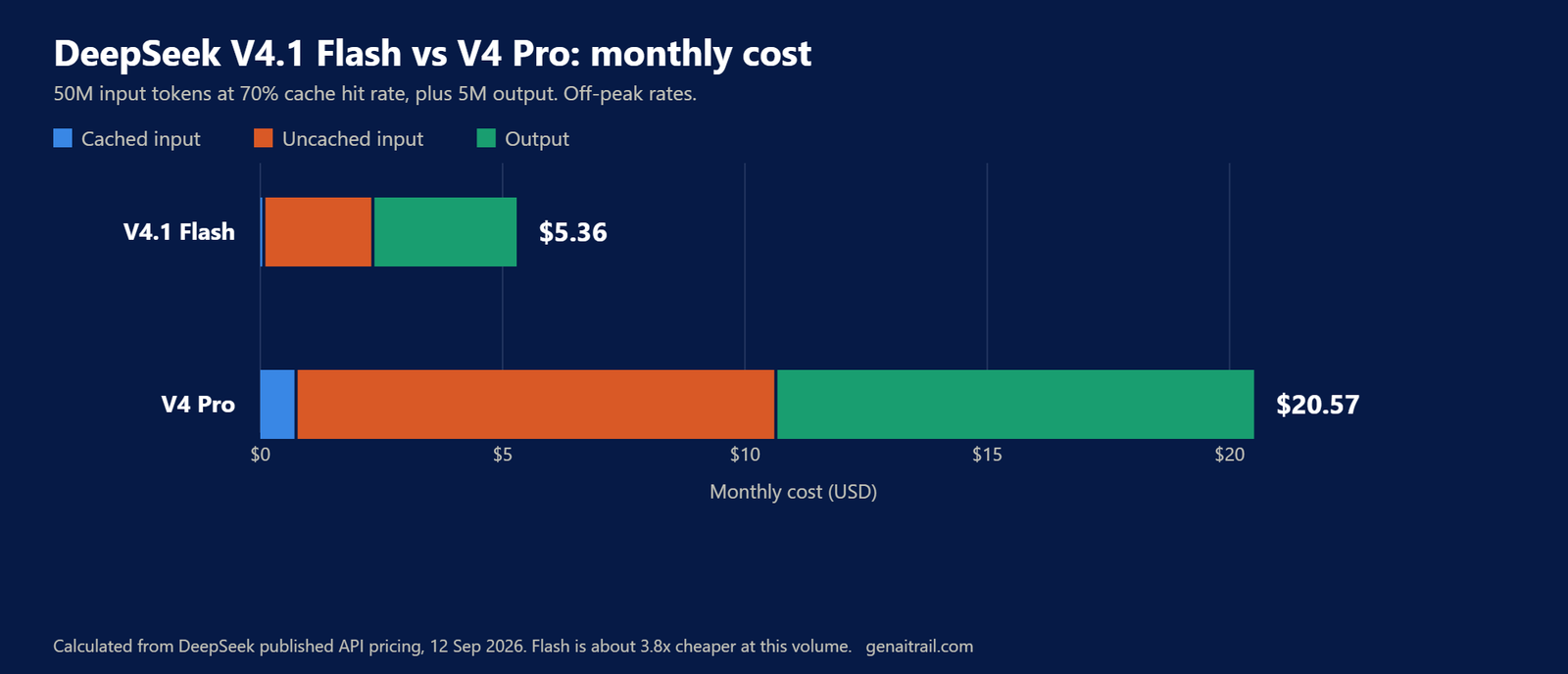
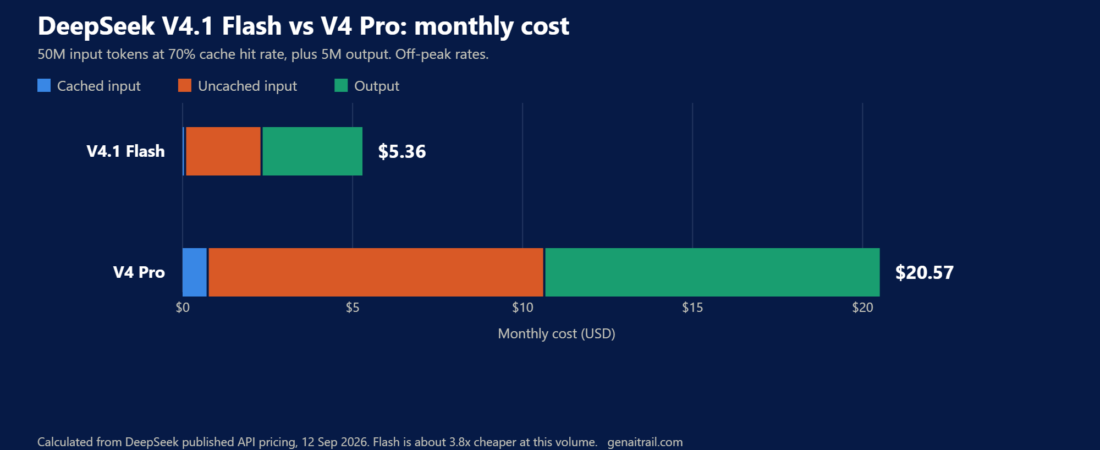
A worked example, off-peak: 50M input tokens a month at a 70% cache hit rate, plus 5M output tokens. On Flash that is $0.11 cached input, $2.25 uncached and $3.00 output — $5.36. The same workload on V4 Pro costs $20.57. Roughly a 74% reduction for changing one string in your config.
Should you move off V4 Pro?
First, a correction to something circulating widely. A number of articles claim V4 Pro is being retired or rerouted to DeepSeek V4.1 Flash on 14 September 2026. That was announced and then reversed. DeepSeek’s current API announcement states that it has “decided to continue providing API services for DeepSeek V4 Pro after September 14, 2026, with the billing method remaining unchanged.” There is no deadline. Nothing breaks.
What has actually changed is narrower: the legacy names deepseek-v4-flash and deepseek-v4-flash-vision-exp are still accepted, but those models are retired and requests are now served by DeepSeek V4.1 Flash at Flash pricing. If you call either name, you are already using the new model.
So the decision is yours to make on merit. Move if your workload is input-heavy, tolerant of a capability difference you have measured, or agentic with high cache reuse. Stay on V4 Pro if you have evaluated both and Pro wins on your tasks — a 74% saving on a workload that now fails more often is not a saving. Test before you switch, ideally against a labelled set rather than a handful of prompts.
DeepSeek V4.1 Flash benchmarks
From DeepSeek’s model card, instruct variant at maximum reasoning effort:
| Benchmark | Score |
|---|---|
| HumanEval (Pass@1) | 79.4 |
| GSM8K (EM) | 93.0 |
| DeepSWE v1.1 (Resolved) | 74.2 |
| Terminal-Bench 2.1 (Pass@1) | 90.6 |
| MMLU-Pro (EM, base) | 74.1 |
Two caveats. These are vendor-reported, and vendors choose which benchmarks to publish. And you will see other figures circulating — GPQA Diamond, Codeforces ratings, CyberGym, SEC-Bench Pro and others — that I could not trace to DeepSeek’s model card or API documentation. They may well be genuine and published elsewhere, but I am not going to repeat numbers I cannot source. Treat any article quoting them without a link with the same caution.
Can you run it locally?
Realistically, no — you will not run DeepSeek V4.1 Flash on anything you would call a workstation. The weights are MIT-licensed and available, and DeepSeek documents Transformers, vLLM and SGLang paths, so it is genuinely open. But 552B parameters have to live somewhere, and the 8B active figure does not help with that.
This is multi-GPU server or rented-cloud territory. A single 24GB or 32GB consumer card is not close, quantisation included. For most people the API is not a compromise, it is the sensible option — and at $0.15 per million uncached input tokens the economics of self-hosting are hard to justify unless you have a data-residency requirement. If you want a capable model that genuinely runs on one GPU, our guide to running a local agent on a single GPU covers a model actually sized for it.
Frequently asked questions
What is the API model name?
deepseek-flash. The legacy V4 Flash names still resolve to it.
Is DeepSeek V4.1 Flash open source?
The weights are released under the MIT licence, which is unusually permissive for a model of this size. That covers the weights; it is not the same as an open training corpus.
Does V4 Pro stop working on 14 September?
No. DeepSeek reversed that plan and has confirmed V4 Pro continues with unchanged billing.
What GPU do I need?
More than one. Treat this as server-class deployment, not a desktop project.
How do I get the cheapest rate?
Run outside 01:00–04:00 and 06:00–10:00 UTC on weekdays, and structure prompts so the stable portion sits at the front and stays byte-identical, which is what earns the cache-hit rate.
The short version
DeepSeek V4.1 Flash is priced for context-heavy and agentic workloads, and the KV-cache compression is what makes that pricing possible rather than a marketing choice. There is no migration deadline. Measure it against your own tasks before switching, because the cost difference is only a saving if quality holds.
All figures verified against DeepSeek’s API pricing documentation, API announcements and the Hugging Face model card on 12 September 2026. Pricing changes; check the source before budgeting. More in Generative AI.
