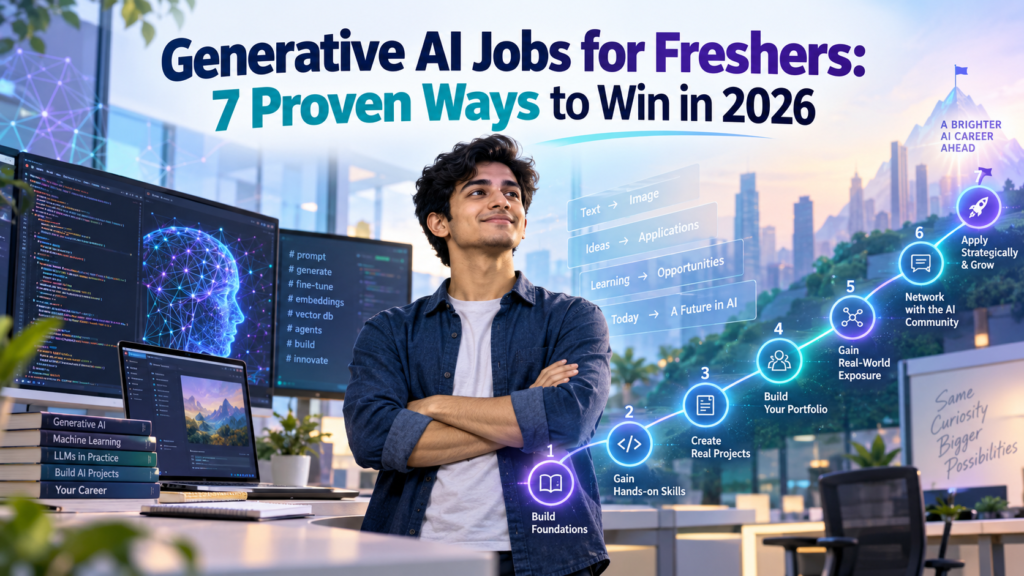
Generative AI Jobs for Freshers: 7 Proven Ways to Win in 2026
Generative AI Jobs for Freshers are no longer limited to research laboratories or candidates with advanced machine-learning degrees.
In 2026, companies are hiring graduates to work on large language models, retrieval-augmented generation, AI agents, evaluation systems, automation tools, and AI-powered applications.
LinkedIn’s 2026 India Grad’s Guide identified AI Specialist and Generative AI Engineer as the two fastest-growing job titles for career starters in India, followed by Digital Content Creator. LinkedIn says the analysis was based on anonymized and aggregated data from millions of member profiles.
That does not mean getting hired has suddenly become easy.
The difficult part for freshers is that employers increasingly want evidence that you can actually build with AI.
Knowing what an LLM is isn’t enough.
Completing ten courses isn’t enough.
Adding “prompt engineering” to a résumé isn’t enough.
A stronger candidate can show a recruiter:
- a working application;
- the architecture behind it;
- a GitHub repository;
- evaluation results;
- failure cases;
- deployment experience;
- and an explanation of why certain technical decisions were made.
This guide gives you a practical six-month roadmap for preparing for Generative AI Jobs for Freshers in 2026, including what to learn, what to build, which projects are worth your time, what salaries are realistic, and how to turn a portfolio into interview opportunities.
Why Generative AI Jobs for Freshers Are Growing in 2026
The biggest change is not simply that companies are “using AI.”
The kind of AI work being done inside companies has expanded.
A few years ago, an entry-level AI role might have focused mainly on:
- preparing datasets;
- training traditional machine-learning models;
- data analysis;
- computer vision;
- basic NLP;
- or maintaining existing ML pipelines.
Those skills are still valuable.
But generative AI has created another application layer.
Teams now need engineers who can connect foundation models to documents, databases, APIs, software tools, and business workflows.
That creates opportunities around:
- LLM application development;
- retrieval-augmented generation;
- AI agents;
- model evaluation;
- prompt and context engineering;
- AI observability;
- multimodal applications;
- workflow automation;
- and AI infrastructure.
LinkedIn’s India Grad’s Guide provides useful evidence of that shift: AI Specialist and Generative AI Engineer were the fastest-growing titles identified for Indian career starters in its 2026 analysis.
But there is an important warning.
A growing field does not mean every job advertised as “Generative AI Engineer” is entry level. Many public listings still require previous engineering experience.
That is why candidates looking for Generative AI Jobs for Freshers should search beyond one exact job title.
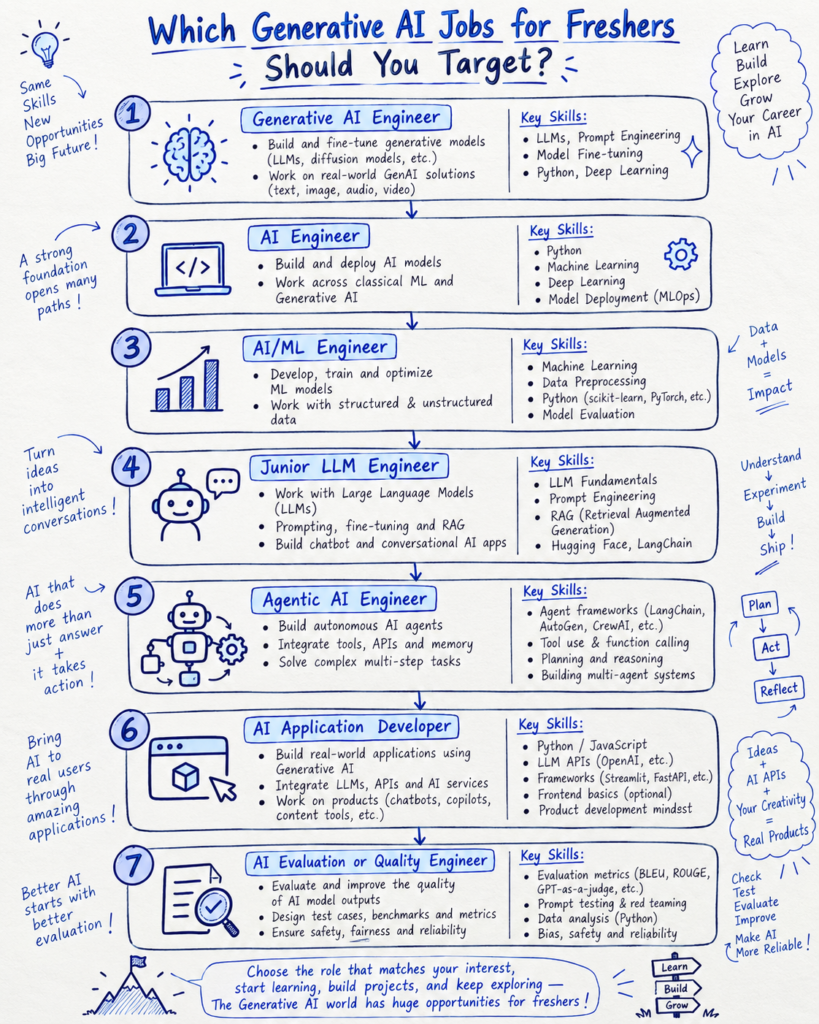
Which Generative AI Jobs for Freshers Should You Target?
Job titles are still inconsistent across companies.
A role involving almost identical work may be advertised under completely different names.
1. Generative AI Engineer
This is the obvious target.
Typical work can include:
- integrating LLM APIs;
- building RAG applications;
- implementing AI agents;
- connecting external tools;
- evaluating model outputs;
- optimizing prompts;
- and deploying AI services.
2. AI Engineer
Some companies use the broader title AI Engineer even when the actual role is heavily focused on LLM applications.
Do not ignore these listings.
3. AI/ML Engineer
These positions may combine traditional machine learning with generative AI.
They can be good entry points because you’ll develop broader fundamentals rather than learning only one framework.
4. Junior LLM Engineer
Smaller AI companies and startups sometimes advertise roles specifically around:
- LLMs;
- embeddings;
- RAG;
- agents;
- fine-tuning;
- evaluation;
- or inference.
5. Agentic AI Engineer
Agent-oriented jobs are becoming more visible.
A current fresher-oriented listing in India, for example, asks for fundamentals in Python, machine learning, APIs, databases, cloud platforms, AI agents, LangGraph, Docker, and related tooling.
6. AI Application Developer
These jobs often look more like software engineering than research.
That can actually be good news for freshers.
You may spend more time:
- writing Python;
- building APIs;
- working with databases;
- calling models;
- debugging workflows;
- deploying applications;
- and measuring output quality.
7. AI Evaluation or Quality Engineer
Every AI application eventually needs testing.
Evaluation work can include:
- creating test datasets;
- measuring retrieval quality;
- checking hallucinations;
- testing prompt versions;
- validating structured output;
- examining regressions;
- and reviewing model failures.
If you understand both development and evaluation, you become significantly more useful than someone who can only produce an AI demo.
For a deeper overview of career directions, read GenAITrail’s AI Career Opportunities guide. AI Career Opportunities on GenAITrail
What Skills Do Generative AI Jobs for Freshers Require?
Real job descriptions provide a better curriculum than random social-media learning roadmaps.
One current entry-level Generative AI Engineer listing asks fresh graduates for basic understanding of:
- RAG;
- embeddings;
- vector databases;
- LLMs;
- Python;
- LangChain or LangGraph;
- cloud platforms;
- CI/CD;
- and AI safety concepts.
That list tells us something important.
You do not need to become an expert in every branch of artificial intelligence before applying.
You need enough knowledge to build an end-to-end application.
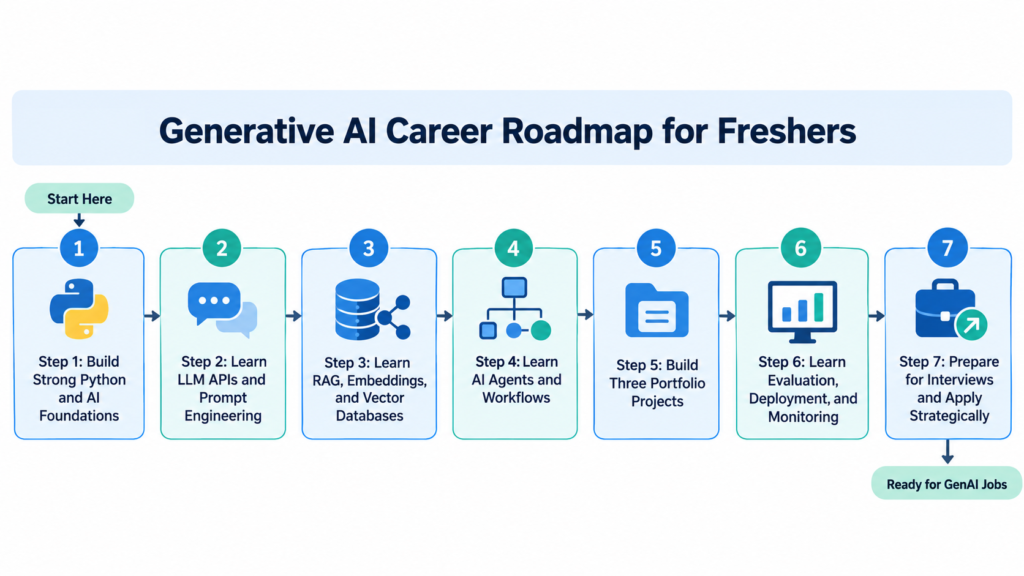
A practical skill stack is:
Programming → LLM API → Retrieval → Agent workflows → Evaluation → API/backend → Deployment
Let’s build that stack step by step.
Step 1: Build Strong Python and AI Foundations
Spend approximately the first four weeks strengthening fundamentals.
Learn Python for Building Applications
You don’t need every obscure Python feature.
You should, however, be comfortable with:
- variables;
- dictionaries;
- lists;
- functions;
- classes;
- exceptions;
- modules;
- virtual environments;
- file handling;
- JSON;
- HTTP requests;
- environment variables;
- async basics;
- and package management.
You should be able to read an API response, transform it, store information, handle errors, and expose a result through another API.
That is far more useful for Generative AI Jobs for Freshers than memorizing advanced Python trivia.
Learn Enough Machine Learning to Understand the System
Before jumping into LangChain or agents, understand:
- training vs inference;
- supervised learning;
- neural networks;
- transformers;
- tokens;
- nlp
- embeddings;
- context windows;
- temperature;
- model parameters;
- fine-tuning;
- and inference latency.
You don’t need to derive every transformer equation during your first month.
But when something goes wrong, you should have a mental model of the components involved.
Step 2: Learn LLM APIs and Prompt Engineering
Weeks four to six should focus on working directly with language models.
Start by calling a model API without a framework.
Build small programs for:
- summarization;
- classification;
- extraction;
- question answering;
- structured JSON output;
- and function/tool calling.
Learn how to control:
- system instructions;
- user prompts;
- context;
- temperature;
- token limits;
- structured output;
- retries;
- and error handling.
DeepLearning.AI’s ChatGPT Prompt Engineering for Developers remains a beginner-level resource covering prompt construction, iteration, summarization, transformation, inference, and application development.
DeepLearning.AI Prompt Engineering course
However, do not spend two months studying prompts.
Prompt engineering is one layer of an application.
A strong candidate for Generative AI Jobs for Freshers also understands what happens before and after the model call.
Step 3: Learn RAG, Embeddings, and Vector Databases
Retrieval-Augmented Generation is one of the most practical topics for a fresher to learn.
A simplified RAG pipeline looks like this:
Documents → Chunking → Embeddings → Vector database → Retrieval → LLM → Answer
You should understand every box.
Learn Embeddings
An embedding converts information into a numerical vector representing semantic information.
Applications can then compare those vectors during retrieval.
Learn Vector Search
You can begin with:
- pgvector;
- Pinecone;
- Weaviate;
- Chroma;
- FAISS;
- or another vector search system.
You don’t need all of them.
Pick one.
For example, pgvector adds vector similarity search to PostgreSQL and currently supports exact and approximate nearest-neighbour search along with distances such as cosine and L2.
Learn Chunking
Chunking deserves more attention than most beginner tutorials give it.
A retrieval system can fail even with an excellent embedding model if the answer is split across bad chunks.
Understand:
- fixed-size chunking;
- recursive chunking;
- semantic chunking;
- overlap;
- metadata;
- parent-child retrieval;
- and the trade-off between retrieval precision and context coverage.
GenAITrail already has a practical comparison of fixed, recursive, and semantic RAG chunking strategies. RAG Chunking Strategies Tested
Learn Retrieval Evaluation
Don’t stop when your chatbot “looks right.”
Measure it.
Useful metrics include:
- Recall@k;
- Precision@k;
- MRR;
- correct-chunk rank;
- context relevance;
- answer faithfulness;
- and answer accuracy.
That evaluation mindset will matter later when you’re discussing your project in an interview.
Step 4: Learn AI Agents and Workflow Engineering
Once you are comfortable building ordinary LLM applications, move into tool-using workflows.
An AI agent typically combines an LLM with:
- tools;
- state;
- decisions;
- APIs;
- memory or context;
- loops;
- and stopping conditions.
Start small.
Build an agent that can:
- receive a question;
- decide whether it needs a tool;
- call an API;
- process the result;
- and return a grounded answer.
Do not start by building a ten-agent autonomous company.
Complexity hides mistakes.
For your first framework, LangGraph and CrewAI are both worth exploring.
If you’re deciding which one to learn, GenAITrail has a detailed LangGraph vs CrewAI comparison with executable examples. LangGraph vs CrewAI 2026 guide
A recruiter will usually care less about which framework logo appears on your résumé than whether you understand:
- workflow state;
- retries;
- tool permissions;
- deterministic steps;
- human approval;
- failure handling;
- and observability.
Step 5: Build Three Projects for Your Generative AI Portfolio
This is where your preparation for Generative AI Jobs for Freshers becomes visible.
Build three projects.
Not fifteen unfinished notebooks.
Three serious projects are enough if each demonstrates a different skill.
Project 1: Production-Style RAG Assistant
Avoid creating another basic “upload PDF and chat” demo.
Instead choose a narrow domain.
Examples:
- university regulations;
- product documentation;
- software manuals;
- government reports;
- technical research papers;
- company policies;
- or your own technical notes.
Your application should include:
- document ingestion;
- chunking;
- embeddings;
- vector search;
- citations;
- retrieval logging;
- evaluation questions;
- and an unanswerable-question strategy.
Then compare at least two configurations.
For example:
| Configuration | Recall@5 | MRR | Answer Accuracy |
|---|---|---|---|
| Fixed chunking | Your result | Your result | Your result |
| Recursive chunking | Your result | Your result | Your result |
Use your actual measurements.
Do not invent benchmark results.
That turns a generic project into evidence of engineering ability.
Project 2: Tool-Using AI Agent
Build an agent that solves one useful workflow.
Examples:
- GitHub issue triage;
- research assistant;
- support-ticket routing;
- travel-information aggregator;
- documentation assistant;
- SQL analysis agent;
- or developer troubleshooting assistant.
Include:
- two or three tools;
- structured tool schemas;
- timeout handling;
- retries;
- logging;
- and a human-confirmation step for risky actions.
Document at least three cases where the agent chose the wrong tool or made a bad decision.
Then explain how you fixed them.
That section will often be more interesting than the successful demo.
Project 3: LLM Evaluation Dashboard
This is the project that can differentiate you from candidates who only build chatbots.
Create a small evaluation system that tracks:
- answer accuracy;
- groundedness;
- retrieval relevance;
- hallucination failures;
- latency;
- token usage;
- and failed test cases.
LangSmith supports both offline evaluation against datasets and online evaluation of production traces, including code-based and LLM-as-a-judge evaluators.
LangSmith evaluation documentation
You can also study GenAITrail’s guide to LLM-as-a-Judge evaluation for practical evaluation patterns and failure modes. LLM as a Judge guide
Step 6: Learn Evaluation, Deployment, and Monitoring
A notebook is useful for experimentation.
It is not the same as a deployed application.
By month five, turn at least one project into a service.
Learn:
- FastAPI or Flask;
- REST APIs;
- Docker;
- Git;
- GitHub Actions basics;
- environment variables;
- secrets management;
- basic logging;
- cloud deployment;
- and simple monitoring.
Choose one cloud platform.
AWS, Azure, and Google Cloud are all acceptable starting points.
You do not need three.
The objective is to understand what changes when an application leaves your laptop.
Questions you should eventually be able to answer include:
- Where are API keys stored?
- What happens if the model provider times out?
- How do you retry safely?
- What happens when the vector database fails?
- How do you track latency?
- How do you identify bad responses?
- What happens when the prompt changes?
- How do you prevent unlimited tool calls?
- How would you control cost?
Those are production questions.
Answering them well is valuable when interviewing for Generative AI Jobs for Freshers.
Step 7: Prepare for Interviews and Apply Strategically
Do not wait until month six to open your first job description.
Start reading them early.
Create a spreadsheet with:
- company;
- role;
- required skills;
- preferred skills;
- experience;
- location;
- salary if available;
- application date;
- response;
- and interview status.
After reading 50 relevant listings, patterns will emerge.
Use those patterns to decide what to learn next.
Search Beyond “Generative AI Engineer”
Try combinations such as:
- Junior AI Engineer
- AI Engineer Fresher
- LLM Engineer
- AI Application Developer
- AI/ML Engineer
- Agentic AI Engineer
- RAG Engineer
- Python GenAI Developer
- AI Automation Engineer
- AI Evaluation Engineer
- Machine Learning Engineer
This matters because Generative AI Jobs for Freshers often appear under broader titles.
Prepare to Explain Your Projects
Interviewers can quickly tell whether a candidate built the project or copied a tutorial.
Be ready to explain:
- why you selected your embedding model;
- why you chose a chunk size;
- how retrieval was evaluated;
- where hallucinations occurred;
- which database you selected;
- why an agent was necessary;
- what failed during deployment;
- how much latency each stage added;
- and what you would change with more time.
For practice, GenAITrail’s 250 AI and Machine Learning Interview Questions can help identify knowledge gaps. AI and Machine Learning Interview Questions
For architecture rounds, use the LLM System Design Interview guide. LLM System Design Interview guide
Generative AI Jobs for Freshers Salary in India
Salary data should be treated carefully because compensation varies dramatically by company, city, degree, skill level, internship experience, and role.
There is, however, evidence that AI skills are improving some fresher offers.
In August 2026, LinkedIn News India summarized reporting that AI-skilled engineering students were increasingly receiving campus packages in the ₹7–12 lakh range, replacing some older ₹3–4 lakh packages. The same report noted broader fresher hiring recovery but also emphasized that hiring conditions differ across industries.
A more useful expectation framework is therefore:
| Candidate Profile | Possible Outcome |
|---|---|
| Basic programming + coursework | Competes for standard entry-level technology roles |
| Python + GenAI projects | Stronger fit for AI application roles |
| Projects + internship | More credible for dedicated AI positions |
| Projects + deployment + evaluation | Stronger evidence of production readiness |
| Strong portfolio + competitive coding/software skills | Access to a wider range of engineering roles |
Do not choose a career solely because someone on social media claims every fresher AI engineer earns ₹20 lakh.
Some candidates will earn significantly more than average.
Some will earn significantly less.
Treat salary as the result of your skills, employer, interview performance, location, and market conditions rather than as a guaranteed reward for learning generative AI.
Certifications for Generative AI Jobs for Freshers
Certifications can help structure your learning.
You can also use GenAITrail practice tests to prepare with hands-on certification-style questions.
They should not replace projects.
IBM Generative AI Engineering Professional Certificate
IBM currently offers a Generative AI Engineering Professional Certificate through Coursera. Its curriculum includes Python, machine learning, PyTorch, transformers, RAG, vector databases, LangChain, fine-tuning, and generative AI applications.
IBM Generative AI Engineering Professional Certificate
For a beginner who wants a structured program, this is more relevant than collecting unrelated certificates.
AWS Certified Machine Learning Engineer – Associate
AWS’s Machine Learning Engineer – Associate certification focuses on implementing and operationalizing ML workloads.
As of September 29, 2026, AWS has opened the updated MLA-C02 beta, which adds areas including generative AI, RAG, foundation models, agentic AI, and responsible AI. AWS says the intended candidate has roughly one year of relevant experience, so this should generally come after hands-on practice rather than before your first project.
AWS Machine Learning Engineer Associate certification
Do Not Plan Around the TensorFlow Developer Certificate
Older career guides still recommend the Google TensorFlow Developer Certificate.
That advice is outdated.
TensorFlow’s official certificate page states that the TensorFlow Certificate exam has been closed while the program’s future is evaluated.
This is exactly why career roadmaps should be checked against current primary sources.
The Experience Paradox: How Can a Fresher Get Experience?
You’ve probably seen listings like this:
Entry-level AI Engineer
2–3 years experience required.
It is frustrating, but you can still build evidence.
You cannot manufacture professional employment history.
You can manufacture opportunities to solve real technical problems.
Build a Shadow Project
Pick a real product category.
Imagine the company has this problem:
Thousands of support documents exist, and users struggle to find answers.
Build a RAG assistant.
Measure retrieval.
Document edge cases.
Deploy it.
Write a short engineering case study.
Now your portfolio tells a story:
Problem → architecture → implementation → evaluation → failure → fix → result
That is dramatically stronger than:
“Completed LangChain tutorial.”
Contribute to Open Source
Fix:
- documentation;
- examples;
- tests;
- small bugs;
- integrations;
- or evaluation datasets.
You don’t need to rewrite an entire framework.
The goal is to experience:
- issue discussion;
- code review;
- pull requests;
- tests;
- and collaboration.
Build for a Real User
Offer to automate one repetitive workflow for:
- a college club;
- a small business;
- a student group;
- an open-source community;
- or a nonprofit.
Real users expose problems tutorials never reveal.
First 30 Days Roadmap for Generative AI Jobs for Freshers
Week 1
- Install Python and VS Code.
- Learn virtual environments.
- Learn Git and GitHub.
- Review Python functions, dictionaries, exceptions, classes, and file handling.
- Call one public API from Python.
Week 2
- Learn how LLM APIs work.
- Build a basic chat interface.
- Test system prompts.
- Generate structured JSON.
- Add exception handling.
- Track token usage.
Week 3
- Learn embeddings.
- Create vectors for a small document collection.
- Store them in a vector database.
- Retrieve similar documents.
- Compare several queries manually.
Week 4
Build version one of your RAG project.
Add:
- document ingestion;
- chunking;
- vector retrieval;
- LLM generation;
- source references;
- and ten evaluation questions.
At the end of 30 days, you should have something running.
It does not need to be impressive.
It needs to be yours.
Common Mistakes When Preparing for Generative AI Jobs for Freshers
Learning Five Frameworks at Once
Do not simultaneously try to master:
- LangChain;
- LlamaIndex;
- LangGraph;
- CrewAI;
- AutoGen;
- Haystack;
- and every new framework appearing on social media.
Framework knowledge ages quickly.
Engineering concepts last longer.
Pick one stack and build something.
Building Only Chatbots
A chatbot interface proves very little by itself.
Show retrieval.
Show evaluation.
Show data flow.
Show monitoring.
Show failures.
Ignoring Software Engineering
GenAI engineering is still engineering.
Learn:
- Git;
- testing;
- APIs;
- databases;
- Docker;
- debugging;
- clean code;
- authentication basics;
- and deployment.
Claiming Results You Never Measured
Do not write:
“My optimized RAG pipeline improved accuracy by 45%.”
unless you actually measured it.
Publish the evaluation dataset and methodology.
Real evidence builds trust.
Listing Every AI Tool on Your Résumé
Recruiters don’t need twenty logos.
Instead of:
LangChain, LangGraph, LlamaIndex, Pinecone, Chroma, FAISS, CrewAI, AutoGen…
show:
Built and evaluated a RAG assistant over 1,200 documents using recursive chunking, pgvector retrieval, and a 60-question evaluation dataset.
The second statement contains evidence.
How to Make Your GitHub Portfolio Stand Out
Every serious project should have a README answering:
What problem does this solve?
One paragraph.
How does it work?
Include an architecture diagram.
How do I run it?
Provide reproducible installation instructions.
What data did you use?
Explain the source and licensing.
How did you evaluate it?
Show your test methodology.
What failed?
This is critical.
Include a section titled:
Known Failure Cases
What would you improve next?
That shows engineering judgment.
Hiring teams should be able to understand the project without opening every Python file.
Frequently Asked Questions About Generative AI Jobs for Freshers
Can freshers get Generative AI jobs in 2026?
Yes. LinkedIn’s 2026 India Grad’s Guide lists Generative AI Engineer among the fastest-growing titles for Indian career starters. However, many GenAI listings still target experienced candidates, so freshers should build practical projects and also search related titles such as AI Engineer, AI/ML Engineer, AI Application Developer, and Agentic AI Engineer.
Is Python enough for a Generative AI job?
Python is an important foundation, but Python alone is generally not enough.
Learn APIs, LLM fundamentals, RAG, databases, evaluation, Git, deployment, and basic software engineering.
Do I need machine learning before learning Generative AI?
You should understand the fundamentals.
You do not need to become a research scientist before building LLM applications, but concepts such as embeddings, inference, transformers, training, evaluation, and vector similarity will make debugging much easier.
Is LangChain required for Generative AI Jobs for Freshers?
No.
LangChain appears frequently in tutorials and job requirements, but companies ultimately need engineers who understand the architecture.
Frameworks change.
The underlying concepts matter more.
Should I learn LangGraph or CrewAI?
Either can be a useful starting point.
CrewAI provides a role-and-task abstraction that is approachable for beginners, while LangGraph gives explicit control over graph state and workflow execution.
Build one real application before trying to learn both.
Do I need to learn fine-tuning?
Not immediately.
For most freshers, RAG, prompting, tool use, evaluation, backend development, and deployment are higher priorities.
Learn fine-tuning once you can explain why prompting or retrieval alone is insufficient for a particular problem.
How many projects should a fresher build?
Three strong projects are enough to create a meaningful portfolio.
A useful combination is:
- a RAG application;
- a tool-using agent;
- an AI evaluation or monitoring project.
Depth matters more than project count.
Are certifications required for Generative AI Jobs for Freshers?
No.
Certifications can provide structure and demonstrate continued learning, but they are strongest when combined with actual applications.
A GitHub repository with reproducible code and measured results gives an interviewer something concrete to discuss.
What should I learn first for Generative AI Jobs for Freshers?
Start with:
Python → APIs → LLM fundamentals → RAG → evaluation → agents → deployment
Avoid beginning with complicated multi-agent frameworks before you can debug a simple LLM API call.
Final 6-Month Roadmap
Here is the complete plan.
| Month | Main Goal | Output |
|---|---|---|
| Month 1 | Python + LLM fundamentals | Small API applications |
| Month 2 | RAG + embeddings + vector search | Basic RAG system |
| Month 3 | Advanced RAG + evaluation | Measured RAG project |
| Month 4 | Agents + tool calling | Agent application |
| Month 5 | Deployment + monitoring | Production-style deployed project |
| Month 6 | Portfolio + interviews + applications | Job-ready GitHub and résumé |
There is no guarantee that completing this roadmap will automatically produce a job.
But it gives you something far more useful than a collection of course certificates.
It gives you evidence.
You can show an interviewer:
Here is the system I built.
Here is how retrieval works.
Here is how I evaluated it.
Here are the queries where it failed.
Here is the change I made.
Here are the new results.
That conversation is much closer to real engineering work.
Final Takeaway
Generative AI Jobs for Freshers in 2026 are real, but the opportunity is more demanding than the hype suggests.
Companies don’t simply need people who know how to chat with an LLM.
They need people who can turn models into useful, measurable, reliable applications.
Your advantage as a fresher is that you can build that evidence before anyone gives you the job title.
Learn Python.
Learn how models are called.
Build retrieval systems.
Understand embeddings.
Experiment with AI agents.
Measure your applications.
Deploy them.
Break them deliberately.
Fix what breaks.
Document what you learned.
Then make your GitHub portfolio prove what your résumé claims.
If you spend the next six months doing that consistently, you will enter the market for Generative AI Jobs for Freshers with something much more persuasive than another certificate:
working systems you can explain from first principles.
Generative AI Jobs for Freshers: MCP, A2A, DeepAgent, and Agent Harness Skills

Modern Generative AI Jobs for Freshers increasingly involve connected tools, reliable workflows, and measurable agent behavior. Learning MCP, A2A, DeepAgent patterns, and agent harness design gives candidates a practical way to discuss architecture in interviews for Generative AI Jobs for Freshers.
MCP for Generative AI Jobs for Freshers
The Model Context Protocol, or MCP, gives an AI application a consistent way to discover and call tools or access contextual resources. For Generative AI Jobs for Freshers, a small MCP project can demonstrate schemas, permissions, error handling, and clear separation between a model and the systems it uses.
Build an MCP server that exposes a safe read-only tool, such as searching documentation or retrieving a project record. Then add validation, timeouts, structured errors, and logs. This is more useful portfolio evidence for Generative AI Jobs for Freshers than listing MCP without showing a working example.
A2A for Generative AI Jobs for Freshers
Agent2Agent, commonly called A2A, describes how independent agents can communicate, discover capabilities, exchange tasks, and return results. Candidates targeting Generative AI Jobs for Freshers can build a small two-agent workflow: one agent plans a research task and a second agent retrieves and verifies sources.
Keep the workflow explicit. Define the task payload, status updates, authentication boundary, retry behavior, and final response format. For Generative AI Jobs for Freshers, explaining why one agent should delegate to another shows systems thinking rather than framework memorization.
DeepAgent and Agent Harness for Generative AI Jobs for Freshers
DeepAgent-style systems go beyond a single prompt by combining planning, tool use, memory, subtask execution, and verification. An agent harness is the surrounding runtime that controls inputs, tools, traces, budgets, approvals, and evaluation. These concepts matter for Generative AI Jobs for Freshers because production agents need boundaries and observability.
For a portfolio project, implement a small harness with a task queue, tool registry, maximum-step limit, structured event log, human approval for risky actions, and a test set. Compare the same task with and without planning. Record success rate, latency, cost, and failure cases. This gives applicants for Generative AI Jobs for Freshers evidence they can evaluate an agent instead of merely demoing it.
A practical learning order for Generative AI Jobs for Freshers is Python, APIs, RAG, MCP tools, A2A task exchange, DeepAgent-style planning, and agent harness evaluation. Start with one reliable workflow, document the architecture, and publish the code with reproducible instructions.
A Portfolio Checklist for Generative AI Jobs for Freshers
- Show one MCP tool with a clear schema and permission boundary.
- Show one A2A-style delegated task with status and retry handling.
- Show DeepAgent-style planning with a step limit and verification.
- Show an agent harness with traces, evaluation data, and failure cases.
- Explain what you would change before using the system in production.
These additions make a portfolio more credible for Generative AI Jobs for Freshers because they connect current agent standards to software engineering fundamentals. The goal is not to use every new tool. The goal is to build a system that can be inspected, tested, and improved.
Use this checklist when preparing for Generative AI Jobs for Freshers. For Generative AI Jobs for Freshers, show the problem, architecture, code, evaluation set, and failure analysis. A portfolio for Generative AI Jobs for Freshers should explain how MCP tools are secured, how A2A tasks are exchanged, and how a DeepAgent workflow is limited by an agent harness. Candidates pursuing Generative AI Jobs for Freshers should measure latency, cost, groundedness, and task success. These details help Generative AI Jobs for Freshers applicants discuss real engineering tradeoffs. A clear README makes Generative AI Jobs for Freshers portfolios easier to review, while reproducible tests make Generative AI Jobs for Freshers applications more credible.
